Mud dauber wasps are solitary, spider-hunting wasps that build nests out of mud — the tubes, globes, and organ-pipe clusters that appear on porch ceilings, garage walls, and under eaves. They are among the least dangerous wasps a homeowner can encounter: they have no colony to defend, they almost never sting, and a single nest removes dozens of spiders from your property. This guide covers how to identify mud dauber wasps and their nests, how to tell an active nest from an abandoned one, what a sting feels like, and how to remove a nest safely when it’s genuinely in the way.
Quick answers for homeowners:
- Are they dangerous? No. Mud daubers are solitary and non-territorial. They do not swarm or defend their nests.
- Do they sting? They can, but very rarely do — only if grabbed, trapped against skin, or handled. The sting is mild.
- What are those mud tubes? Nest cells, each packed with paralyzed spiders and a single wasp egg.
- Should I remove the nest? Usually not. If you must, wait for late fall through early spring when nests are naturally empty, then scrape and wash.
Mud Dauber Wasp Scientific Classification and Common Names
- Primary names: Mud dauber wasp, mud wasp, dirt dauber wasp
- Order: Hymenoptera (ants, bees, and wasps)
- Families: Sphecidae (thread-waisted wasps) and Crabronidae (square-headed wasps)
- Common genera: Sceliphron (black and yellow mud daubers), Chalybion (blue mud daubers), Trypoxylon (pipe organ mud daubers)
- Key identifying feature: Extremely long, thread-like petiole (wasp waist) — the most pronounced of any common wasp
- Geographic range: Throughout the United States, with individual species favoring different regions
Geographic Distribution of Mud Dauber Wasp Species
Regional mud dauber wasp populations:
- Black and yellow mud dauber (Sceliphron caementarium) — the most widespread species, found throughout the continental United States and most abundant in the South and Southeast
- Pipe organ mud dauber (Trypoxylon politum) — an eastern species, common from the Great Plains and Texas east to the Atlantic, and largely absent from the Pacific Northwest and Intermountain West
- Blue mud dauber (Chalybion californicum) — ranges across most of North America, with its core populations in the West and Southwest; the closely related Chalybion zimmermanni fills a similar role in the Southeast
- Urban vs rural: All mud dauber species adapt well to suburban environments that mix natural areas with built structures
Mud daubers vs ground-nesting wasps: Unlike wasps that build colonies in lawn soil (see our guide on wasps in grass identification and management), mud daubers nest on vertical and overhead surfaces. That makes them considerably safer for households with children and pets, since there’s no risk of stumbling onto a hidden nest during yard work.
Seasonal activity patterns by region:
- Southern climates: Activity from March through October, peaking June–August
- Northern regions: A shorter season, May through September, peaking July–August
- Desert Southwest: Extended season February through November, with reduced activity during extreme summer heat
- Coastal areas: Moderate activity March through October with less dramatic seasonal swings
Daily activity patterns and temperature thresholds: Like other wasps, mud daubers become inactive when temperatures drop below roughly 50°F (see our guide on what temperature wasps stop flying for detailed thresholds). When are mud dauber wasps most active? Peak hunting and building activity runs from mid-morning (around 9–11 AM) through late afternoon (3–6 PM), when temperatures are warm enough for sustained flight and spider prey is easiest to reach.
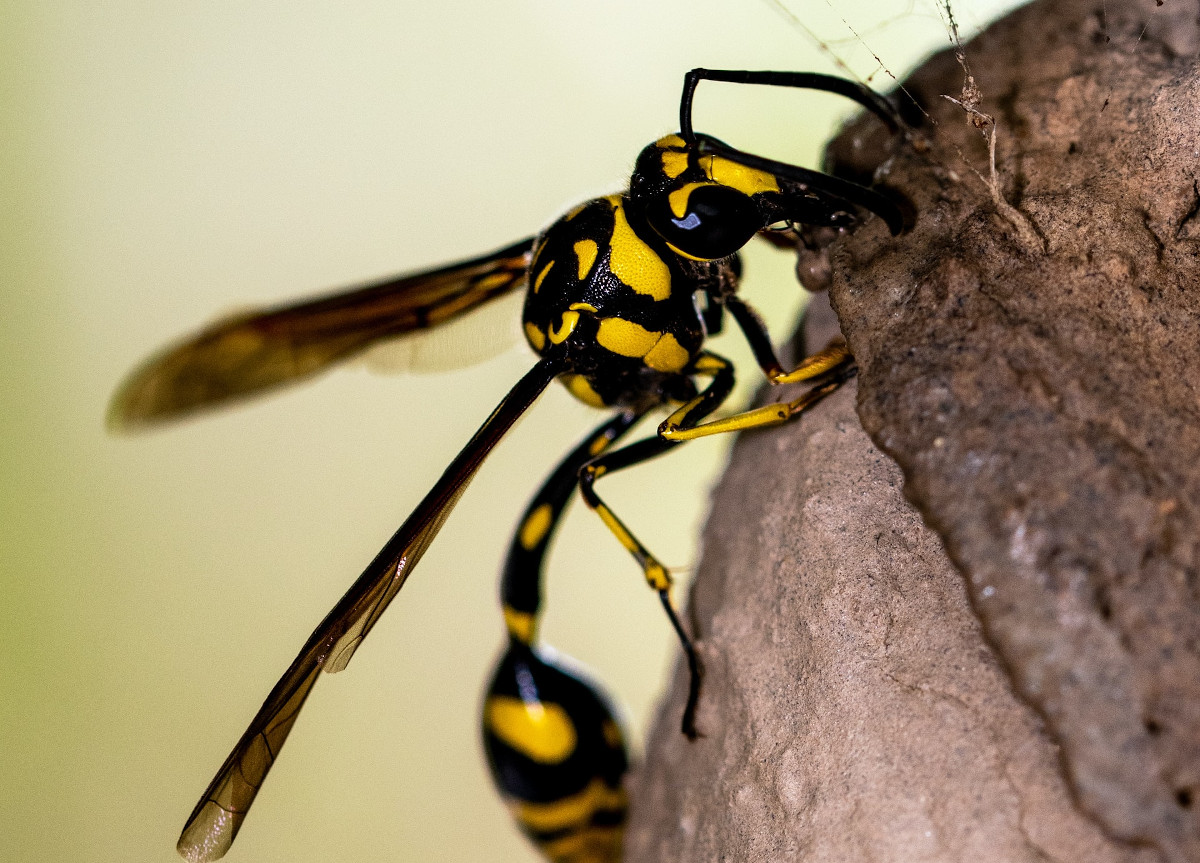
If you’ve ever wondered about the mud tubes and hollow clay balls appearing on your porch or in your garage, you’ve encountered one of the insect world’s great architects.
Are mud dauber wasps dangerous to humans? No — mud daubers are among the least dangerous wasps homeowners meet. They are solitary, meaning each female builds and provisions her own nest without a colony, so there is no group of workers to mount a defense. Unlike species that readily confront people (see wasp aggression levels and triggers), mud daubers avoid human contact. Do mud daubers sting or bite you? They can sting but rarely do, and they never bite defensively.
What attracts mud dauber wasps to your property?
- Water and wet soil: Mud daubers need damp clay or mud for nest construction
- Spider populations: Properties with abundant spiders attract hunting females (see also what eats wasps)
- Protected surfaces: Eaves, porch ceilings, garages, and sheds offer rain-free nesting sites
- Flowering plants: Adults feed on nectar, so gardens draw them in (see our what attracts wasps guide)
- Previous nest sites: Females often return to locations that worked before, and old nests attract nest-reusing species
DIY Wasp removal recommendations
For non-aggressive wasps I've had great luck spraying nests with this Spectracide wasp remover in the evening. For a nest up high in an eave, soffit, or tree, this Gotcha pole adapter clamps onto the can so you can spray from the end of an extension pole and treat the nest from 10+ feet away instead of standing right under it. And for anything aggressive I wear this ridiculous-looking upper torso beekeeping suit and keep my distance. It seems silly, but trust me, I learned the hard way.
Mud Dauber Identification
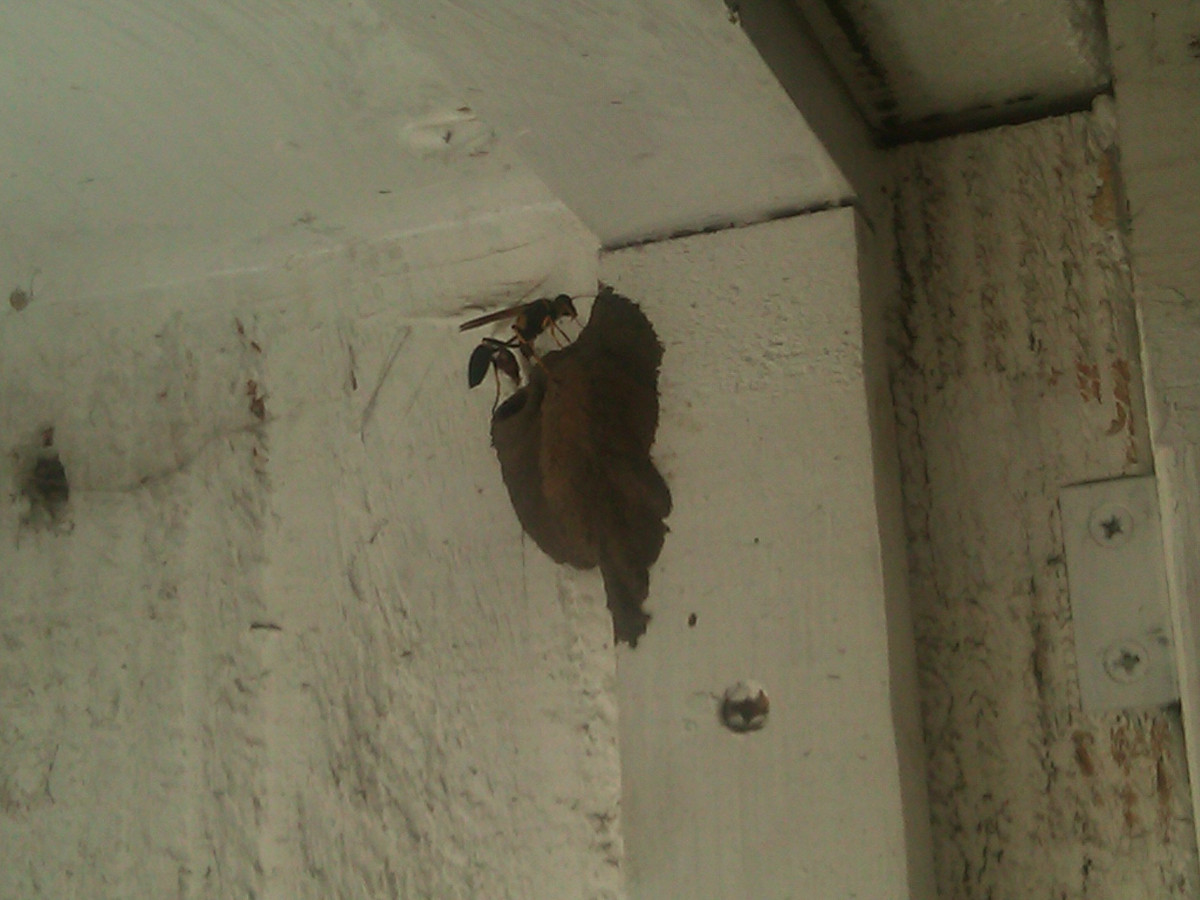 Image by Craig Talbert
The mud nest itself is the fastest identifier. If you’ve watched a flying insect tending a mud structure near your home, you’ve almost certainly found a mud dauber. The wasps are ¾ to 1 inch long with a very thin, elongated ‘waist’ — a petiole connecting the abdomen to the thorax. That thread-like waist is the single most reliable feature separating them from paper wasps and yellowjackets. Coloration and nest architecture vary among species.
They can look like an alarming hornet to an untrained eye, but the exaggerated waist and dangling legs in flight mark them as harmless solitary wasps.
Quick visual checklist:
- Thread-thin waist, legs dangling in flight, tending a mud nest → mud dauber
- Black with bright yellow markings on legs and thorax, round or lumpy mud nest → black and yellow mud dauber
- Shiny blue-black with pale legs, long parallel mud tubes → pipe organ mud dauber
- Iridescent metallic blue, hanging around old round mud nests → blue mud dauber
- Fat-waisted, fuzzy, carrying pollen → a bee, not a mud dauber
The Three Common Mud Dauber Species
Black and yellow mud dauber (Sceliphron caementarium) is the classic nest builder. Black bodied with bright yellow markings on the legs, thorax, and petiole, she gathers mud pellet by pellet and shapes them into a cluster of cells that eventually looks like a lump of dried clay. This is the species responsible for most of the mud nests homeowners find.
Pipe organ mud dauber (Trypoxylon politum) builds the striking parallel tubes that give it its name. The wasp is shiny blue-black with distinctive pale, cream-colored markings on the hind legs. It belongs to the family Crabronidae — the ‘square-headed wasps’ — making it only distantly related to the Sphecid mud daubers, despite the shared mud-building habit. Tubular mud nests are its signature. Unusually among wasps, the male pipe organ mud dauber guards the nest while the female forages.
Blue mud dauber (Chalybion californicum) builds almost nothing of its own. Instead it finds abandoned black and yellow mud dauber nests, softens the dried mud with water carried in from a puddle or birdbath, reopens the cells, and provisions them with its own prey — heavily favoring black widow spiders. Its metallic blue-black iridescence is unmistakable in sunlight. We cover this species in depth in our blue mud wasp identification and behavior guide.
For a broader look at how mud daubers differ from social wasps, see mud dauber vs wasp: key differences.
Wasp Nest or Bird Nest?
A few bird nests are easy to mistake for mud dauber work. If you find a mud nest shaped like an open cup on a porch or under an overhang, it’s most likely a barn swallow’s. These insect-eating birds build with mud too, and they readily nest on houses during the warm season. Swallow nests are cup-shaped and open at the top; mud dauber nests are sealed.
Mud Dauber Nest Identification
Accurate nest identification tells you which species you have, whether the nest is still in use, and whether anything needs to be done. Each mud dauber species produces distinctive architecture, and the nest is usually easier to identify than the wasp.
Mud Dauber Nest Types by Species
Black and yellow mud dauber nest (Sceliphron caementarium):
- Shape: A cluster of side-by-side cells, plastered over into a rounded or lumpy mass resembling dried clay
- Size: Typically 2–4 inches across, sometimes larger where a good site is reused
- Color: Light brown to tan, matching the local mud or clay source
- Texture: Visible ridged bands from individual mud loads, often smoothed over with a final mud coat
- Location: Under eaves, in garages, sheds, barns, and other protected structures
- Cell contents: Each cell holds several paralyzed spiders and one egg
Pipe organ mud dauber nest (Trypoxylon politum):
- Shape: Long, straight tubes arranged side by side like organ pipes
- Length: Individual tubes commonly 4–6 inches, in parallel clusters
- Diameter: Narrow, roughly ½ inch
- Material: Darker mud with a smoother, more polished finish
- Construction: A single line of cells stacked within each tube
- Cell contents: Provisioned mainly with small orb-weaving spiders
Blue mud dauber nest use (Chalybion californicum):
- Never builds original nests: It colonizes abandoned black and yellow mud dauber structures
- Fresh mud patches: Dark, damp areas on an otherwise dry old nest indicate recent reopening and resealing
- Modified openings: Reopened and re-plastered cells rather than a new nest shape
- Activity signs: Black widow remains near the nest are a strong indicator
- Timing: Peaks in mid to late summer, once the previous season’s nests are available
Potter wasp nests (Eumenes species) are sometimes mistaken for mud daubers. They’re tiny mud jugs — 1 inch or less, urn-shaped with a narrow neck — and they’re provisioned with caterpillars rather than spiders.
For more detail on distinguishing and safely removing each nest type, see our mud wasp nest identification and removal guide.
Mud Nests vs Paper Nests: What Kind of Wasp Nest Looks Like Mud?
Only mud daubers and potter wasps build with mud. Everything else in the common wasp lineup builds with paper — chewed wood pulp — which looks and feels completely different: gray, fibrous, and light, versus hard, gritty, and earth-colored.
| Nest Type | Material | Shape | Size | Social Structure |
|---|---|---|---|---|
| Mud dauber | Clay/mud | Lumpy cluster or parallel tubes | 2–6 inches | Solitary |
| Potter wasp | Clay/mud | Tiny jug with narrow neck | Under 1 inch | Solitary |
| Paper wasp | Paper pulp | Open umbrella comb | 3–8 inches | Colonial (20–75) |
| Yellowjacket | Paper pulp | Large enclosed, often hidden | 6–24 inches | Large colonies |
| Hornet | Paper pulp | Enclosed, football-shaped | 12–24 inches | Colonial |
Getting this right matters: a mud nest means a solitary wasp you can safely ignore, while a papery enclosed nest at ground level or in a wall void may be a yellowjacket colony that needs a very different approach. See our complete wasp nest identification guide if you’re unsure.
How to Tell If a Mud Dauber Nest Is Active
Knowing whether a nest is still in use determines whether you can remove it casually or should wait. Most mud nests homeowners notice are already finished and sealed.
Signs of an active nest:
- Adult wasps visiting: A female returning repeatedly is the most reliable indicator
- Prey transport: Wasps arriving with paralyzed spiders held beneath the body
- Fresh mud: Recently added sections look darker and damper than the rest of the nest
- Open cells: An unsealed cell means provisioning is still underway
- Growth over time: The nest getting visibly larger week to week
Signs of an abandoned nest:
- Round emergence holes: Neat holes chewed outward by adults that have already left — the clearest sign the nest is finished
- Dry, cracked mud: Weathering, fading, and crumbling edges
- Moss, lichen, or dust buildup on the surface
- Woodpecker or wren damage: Ragged holes where birds have dug out larvae
- No repairs: Damage left unfixed over several days
How to observe safely:
- Keep 6–10 feet away during assessment
- Watch for 15–20 minutes before concluding a nest is inactive
- Check across 2–3 days, since a single female may be away foraging for long stretches
- Best window is 9 AM to 4 PM on a warm, sunny day (70°F+) — see what temperature wasps stop flying
- Use binoculars or a zoom lens rather than approaching closely
Seasonal shortcut: From late fall through early spring, essentially every mud dauber nest in the country is empty. If it’s November through February, you can skip the observation and simply remove it.
Natural History
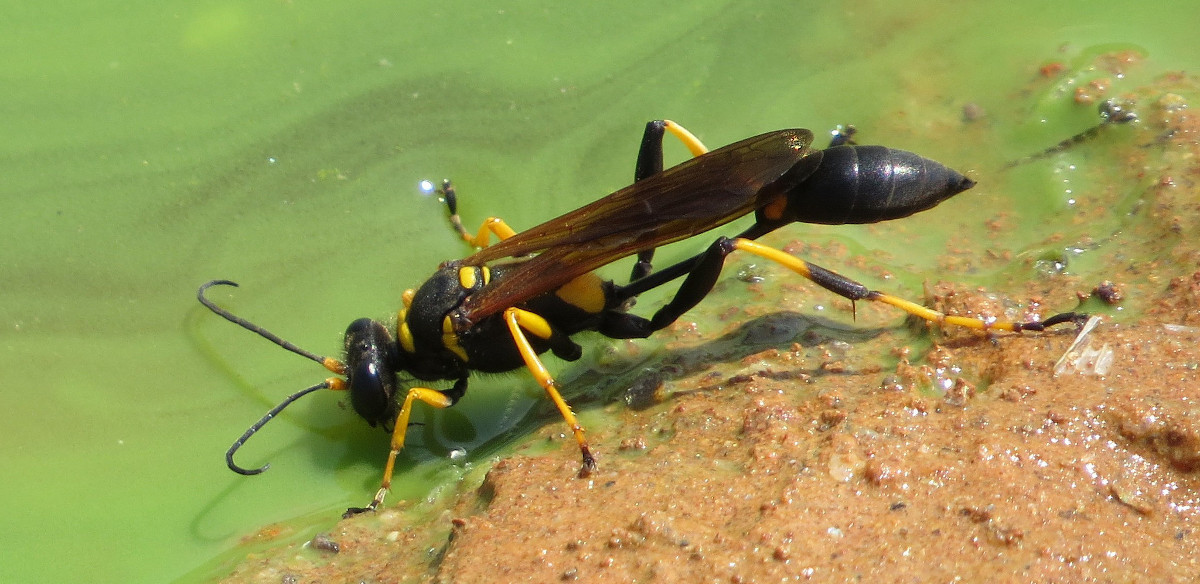 Photo by David Hill
Mud daubers are dozens of species across two families in the order Hymenoptera: Sphecidae and Crabronidae. That makes them relatives of ants, bees, and the social wasps — but their solitary lifestyle sets them apart behaviorally from nearly everything homeowners think of as a “wasp.”
Mud Dauber Nests Are Nurseries, Not Colonies
Mud daubers hunt spiders, paralyze them with venom, and store them alive inside sealed mud cells until the larvae are ready to eat. The blue mud dauber takes this furthest, provisioning with black widows — among the most venomous spiders in North America.
Each nest contains one to several cells, functioning as cradles for the young. Females are the sole architects and builders. As she completes each cell, the female packs in captured spiders, lays a single egg, and seals the cell shut. The egg hatches into a larva that feeds on the still-living spiders before pupating and eventually emerging as an adult. Cells can contain up to 25 spiders apiece.
Adult mud daubers themselves feed on flower nectar. Their days are spent visiting flowers, collecting mud at puddle edges, hunting spiders, and provisioning cells. They’re among the relatively few insects that invest in provisioning for their offspring at all.
How Long Do Mud Dauber Nests Last? Lifecycle and Durability
Mud dauber nests are actively used for a single season, then persist as empty shells for anywhere from a few months to well over a year, depending on how sheltered they are. Understanding the timeline explains both when removal is safe and why old nests keep reappearing in the same spots.
Spring construction (March–May):
- Females begin building after emerging and mating, favoring warm days around 70–80°F
- Each cell takes roughly 1–3 days to build and provision
- Most nests reach full size within a few weeks, typically with a handful of cells
Summer development (May–August):
- Eggs hatch within a few days; larvae feed on stored spiders for several weeks
- Larvae then spin cocoons and pupate inside the sealed cells
- In warmer regions, a second generation may emerge and nest the same year
- The founding female dies once she has finished provisioning, usually by midsummer
Fall and winter (September–February):
- Mud dauber activity ceases by early fall in most regions
- Offspring overwinter as pupae inside the sealed cells, emerging the following spring
- Nests remain in place as hard mud shells, gradually weathering
What determines how long the empty structure lasts:
- Weather exposure: Nests under deep eaves or inside garages can stay intact for a year or more; fully exposed nests break down in a few months
- Mud composition: Clay-rich mud binds far better and resists weathering longer than sandy or silty material
- Freeze-thaw cycles: Repeated freezing and thawing breaks mud structures down quickly in cold-winter regions
- Rain and runoff: Direct rain dissolves unprotected nests fastest
- Vibration: Nests on doors, gates, or machinery loosen and fall sooner
- Bird damage: Woodpeckers, wrens, and titmice tear nests open to reach larvae
Why old nests matter: An abandoned nest isn’t inert. Blue mud daubers depend entirely on them, and returning black and yellow mud daubers frequently build alongside a previous nest. Removing old nests in winter is the single most effective way to discourage nesting in a specific spot the following year.
Do Mud Dauber Wasps Sting or Bite You?
Short answer: mud dauber wasps can sting but rarely do, and they do not bite humans. They are among the least aggressive of all wasps and pose far less risk than social species like yellowjackets or paper wasps.
Sting risk comparison:
- Mud dauber wasps: Extremely low (defensive only, if handled)
- Paper wasps: Moderate (will defend the nest)
- Yellowjackets: High (aggressive colony defense)
- Hornets: Very high (intense nest defense)
Understanding Mud Dauber Defensive Behavior
Why mud daubers rarely sting:
- Solitary nature: With no colony and no workers, there is nothing to mount a group defense
- Non-territorial: They don’t patrol or defend a perimeter around the nest
- Single-minded: Their attention is on hunting spiders and building, not on you
- Avoidance: When disturbed, a mud dauber flies off rather than engaging
When a mud dauber might sting:
- Direct physical contact: Grabbed, stepped on, or trapped against skin or inside clothing
- Nest handling with the wasp present: Scraping an active nest while the female is home (for timing, see when wasps are most active)
- Accidental encounters: Surprised while drinking at a puddle or feeding on flowers
Mud Dauber Sting Characteristics and Treatment
What the sting is like:
- Pain level: Roughly 1–3 out of 10 — far milder than a yellowjacket or hornet
- Duration: Usually subsides within 15–30 minutes
- Swelling: Minimal and localized
- Venom volume: Small compared with social wasps
- Allergic reactions: Uncommon, but possible in sensitized individuals
Treating a mud dauber sting:
- Wash the site with soap and water to prevent infection
- Apply a cold compress for 10–15 minutes to reduce pain and swelling
- Take an oral antihistamine (diphenhydramine or loratadine) if itching develops
- Use ibuprofen or acetaminophen for discomfort
- Monitor for 2–4 hours for any spreading reaction
Simple home remedies that help with comfort:
- Baking soda paste (3 parts baking soda to 1 part water) applied to the site
- Aloe vera gel for cooling relief
- An ice cube wrapped in cloth if you don’t have a cold pack
Seek medical attention if:
- You have difficulty breathing or swallowing, widespread hives, dizziness, or a rapid pulse — these indicate anaphylaxis and require emergency care
- Swelling spreads well beyond the sting site
- The sting is in the mouth, throat, or near the eye
- You have a known severe wasp sting allergy
- Signs of infection appear after 24–48 hours (increasing redness, warmth, pus)
For full sting treatment protocols across every species, see our comprehensive guide on whether wasps sting or bite, and can wasps sting more than once for how wasp stingers differ from a honey bee’s.
Why Mud Daubers Don’t Bite
Mud daubers do have mandibles, and they use them constantly — for gathering and shaping mud, subduing spiders, and chewing out of the nest at emergence. But they don’t use them defensively against people. Their only defensive tool is the stinger, which they almost never deploy.
Should I Worry About Mud Dauber Wasps?
No. Mud daubers represent one of the lowest-risk wasp encounters possible, and they earn their keep as spider predators. Comparing them directly against the species that do warrant caution makes the difference clear.
| Wasp Species | Sting Risk | Nest Defense | Aggression | Recommendation |
|---|---|---|---|---|
| Mud dauber | Very low | None — solitary | Minimal | Leave alone |
| Paper wasp | Moderate | Moderate | Territorial near nest | Monitor; manage if near a doorway |
| Yellowjacket | High | Intense | Highly aggressive | Professional removal often warranted |
| Hornet | Very high | Extreme | Very aggressive | Professional intervention |
What makes mud daubers so different from the species that cause problems:
- No colony instinct: Social wasps will sacrifice individual workers to defend the group; a solitary mud dauber has no group and no such behavior
- No scavenging: They hunt spiders and drink nectar. They aren’t drawn to your picnic, trash, or soda can — a major source of late-summer yellowjacket stings
- Individual encounters only: You will never face a coordinated attack from multiple mud daubers
- Seasonal and finite: Active for a few months, then gone; nests are never defended across years
- Predictable: Their flight paths are slow and deliberate, and they ignore human presence
For contrast with species that genuinely need active management, see our guides on red wasp behavior and removal and ground-dwelling wasp identification.
Are Mud Daubers Good to Have Around Your Property?
Yes. Mud daubers are beneficial insects most homeowners should simply tolerate. They deliver real pest control while posing almost no risk to people or pets.
Spider Control
- Volume: A single nest can account for dozens of spiders, since each cell may hold up to 25
- Black widow control: Blue mud daubers specialize in widow spiders, one of the few genuinely medically significant spiders in North America
- Broad targeting: Different mud dauber species take orb weavers, jumping spiders, wolf spiders, and other web-builders
- Where it counts: They hunt in exactly the places homeowners least want spiders — porches, garages, sheds, and storage areas
- Sustained effort: A female spends most of her active life hunting to provision cells
Environmental Benefits
Pollination: Adults feed on nectar and visit a wide range of native and cultivated flowering plants, contributing modestly to pollination as they forage.
Food web support: Mud dauber larvae are a protein source for birds. Woodpeckers, wrens, and titmice specifically target mud nests to reach them.
Why Tolerating Them Usually Makes Sense
- No swarming: Each female works alone; there is no colony to grow or defend
- Very low sting risk: Among the most docile wasps you can host
- Temporary: Active only a few months a year
- No structural damage: Mud nests sit on the surface. They don’t bore into wood, chew through siding, or damage stucco — they scrape off and wash away
- No maintenance: They require nothing from you
When Removal Might Be Reasonable
- High-traffic locations: A nest directly over a doorway or on frequently used outdoor furniture
- Children’s play areas: Where curious hands are likely to poke at it
- Appearance: Multiple nests on a prominent front elevation
- Allergies: Households with a documented wasp sting allergy
- Equipment interference: Rare cases where nests block vents, fixtures, or machinery
A balanced approach works well: remove nests only where they’re genuinely a problem, wait for the dormant season when you can, and leave the rest to keep working on your spiders.
Mud Dauber vs Paper Wasp
Telling mud daubers from paper wasps is the most useful identification a homeowner can make, because it determines whether the nest can be ignored or needs a careful approach. Both are beneficial, but only one will defend itself.
Visual differences:
| Feature | Mud Dauber | Paper Wasp |
|---|---|---|
| Waist | Extremely narrow, thread-like petiole | Narrow but far less extreme |
| Size | ¾ to 1 inch | ¾ to 1 inch |
| Color | Metallic blue-black, or black with bright yellow markings | Brown and reddish with yellow markings, yellow legs |
| Legs in flight | Dangle conspicuously | Tucked closer to the body |
| Flight | Slow, deliberate | Faster and more direct |
| Nest material | Hard mud and clay | Gray papery pulp |
| Nest shape | Lumpy cluster or parallel tubes, sealed | Open umbrella-shaped comb with visible hexagonal cells |
Behavioral differences:
| Characteristic | Mud Dauber | Paper Wasp |
|---|---|---|
| Social structure | Completely solitary | Colonial — 20–75 individuals |
| Nest defense | None | Will defend the colony |
| Sting frequency | Extremely rare | Moderate, near the nest |
| Prey | Spiders exclusively | Caterpillars and assorted insects |
| Human interaction | Actively avoids | May investigate and challenge |
What to do with each:
- Mud daubers: Leave them. Removal is rarely necessary outside high-traffic spots.
- Paper wasps: Also beneficial, but manage nests within reach of doorways, play areas, or where people sit. Approach at night, and give the nest a wide berth during the day.
When to call a professional: For mud daubers, only for large numbers in high-traffic areas, a household allergy, or nests fouling mechanical equipment. For paper wasps, call for large colonies near entrances or children’s areas, repeated aggressive encounters, or nests inside wall voids where DIY removal is genuinely hazardous.
See our paper wasp complete homeowner guide for full identification and management, and how to get rid of paper wasps for removal specifics.
What Is the Difference Between a Wasp and a Mud Dauber?
Mud daubers are wasps — but they differ from the wasps most people picture in almost every way that matters to a homeowner. (“Dirt dauber vs wasp” is the same question; dirt dauber is just a regional name for the same insect.) The comparison below covers the species you’re most likely to be choosing between.
| Characteristic | Mud Daubers | Paper Wasps | Yellowjackets | Hornets |
|---|---|---|---|---|
| Social structure | Solitary | Colonial (20–75) | Colonial (up to several thousand) | Colonial (100–700) |
| Aggression | Very low | Moderate | High | Very high |
| Nest defense | None | Moderate | Intense | Extreme |
| Nest material | Mud | Paper pulp | Paper pulp | Paper pulp |
| Nest location | Protected vertical surfaces | Eaves, open structures | Ground cavities and wall voids | Trees and structures |
| Body shape | Extremely narrow waist | Narrow waist | Compact | Large, robust |
| Flight | Slow, legs dangling | Direct | Fast, direct | Heavy, direct |
| Sting frequency | Extremely rare | Moderate | Common | Common |
| Diet | Spiders; nectar for adults | Caterpillars, insects, nectar | Insects plus scavenged human food | Insects |
Behavioral summary:
Mud daubers work individually, mount no coordinated defense, hunt only spiders, stay active 3–4 months, and avoid people.
Social wasps (paper wasps, yellowjackets, hornets) defend shared nests under a queen (see wasp colony structure and queens), attack perceived threats to the nest, hunt varied prey and scavenge human food, remain active from spring into late fall, and will investigate people directly.
Blue Mud Dauber: The Black Widow Specialist
The blue mud dauber (Chalybion californicum), also called the metallic blue mud wasp, is the most striking mud dauber and the one most worth protecting — it’s the principal insect predator of black widow spiders.
What sets it apart:
- Appearance: Iridescent metallic blue to blue-black, ¾ to 1 inch, with the characteristic thread-like waist
- Nest reuse rather than building: It doesn’t construct nests. It locates abandoned black and yellow mud dauber nests, carries water in to soften the dried mud, reopens the cells, and reseals them with its own provisions
- Prey preference: Strongly favors widow spiders, though it takes other web-building spiders too
- Range: Found across most of North America, most abundant in the West and Southwest; Chalybion zimmermanni occupies a similar niche in the Southeast
- Season: Peak activity in mid to late summer, once the previous year’s nests are available and spider populations are high
- Behavior to watch for: Slow hover-and-investigate flights through garages, woodpiles, and dark corners — exactly where widows shelter
Signs blue mud daubers are working your property:
- Fresh dark mud patches on otherwise dry, old, round mud nests
- Metallic blue wasps repeatedly visiting existing nests
- Widow spider remains near nest entrances
- Systematic patrolling of storage areas and undisturbed corners
Is it rare? No — blue mud daubers are common across their range, but they’re easy to miss. They’re active only a few months, they’re solitary rather than conspicuous, and they depend on existing mud nests being available, so populations cluster wherever black and yellow mud daubers nested previously.
Should you remove them? Almost never. This is the species doing the most valuable work on your property, and it poses even less risk than other mud daubers because it isn’t building or defending anything of its own. If you want blue mud daubers around, the simplest step is to leave old round mud nests in place through the winter rather than scraping them off.
For a full treatment of identification, behavior, life cycle, and management, see our blue mud wasp complete guide. If you’re trying to identify a blue wasp that may not be a mud dauber at all, start with our blue wasp identification guide — and note that cuckoo wasps, the metallic jewel-toned kleptoparasites that lay eggs in mud dauber nests, are frequently confused with them.
Should I Destroy the Mud Dauber Nest?
In most cases, leaving the nest alone is the right call. But when a nest genuinely needs to go, the method matters less than the timing.
When to Leave Nests Alone
- Pest control value: Each nest represents dozens of spiders already removed from your property
- No threat: Mud daubers don’t defend nests, so an undisturbed nest is not a hazard
- Self-limiting: Nests are used for one season and weather away on their own
- Wildlife value: They support birds that feed on the larvae
- Zero effort: No intervention or ongoing management needed
Locations where nests are usually fine: under eaves away from doors, in garages or sheds off to the side, on outbuilding walls, beneath decks, and in storage areas.
When Removal Is Justified
- Directly over a frequently used doorway where contact is likely
- In a children’s play area where the nest will be poked at
- On a prominent front elevation where appearance matters to you
- In a household with a documented wasp sting allergy
- On a commercial property where liability is a consideration
- Blocking equipment — vents, light fixtures, or machinery
Safe Nest Removal
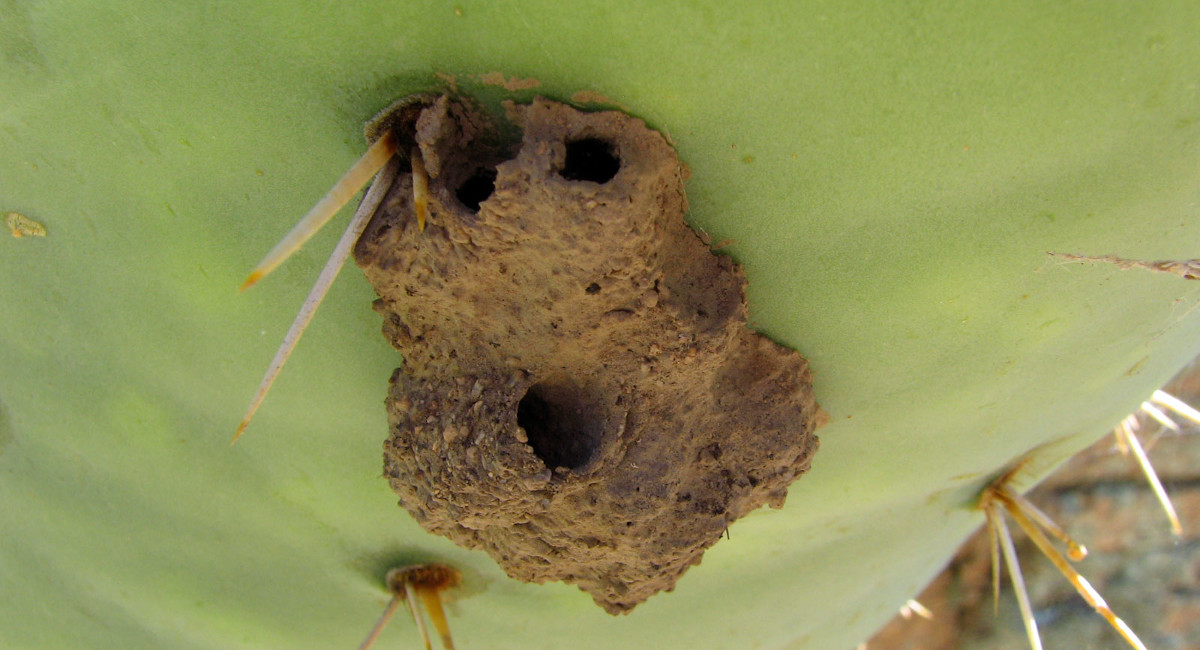 Photo by Katja Schulz
Mud dauber nests are the easiest wasp nests to remove, because you don’t need insecticide at all — just the right timing.
Best timing:
- Season: Late fall through early spring (roughly November–February), when nests are empty
- Time of day: If you must remove during the active season, early morning or dusk when the female is least likely to be present
- Weather: A dry day, so mud doesn’t smear and resettle
- Temperature: Below 60°F reduces wasp activity substantially
Step by step:
- Confirm the nest is inactive — watch for 15–20 minutes, and look for emergence holes
- Wear basic protection — long sleeves, gloves, closed shoes, and eye protection if working overhead
- Use a flat tool — a putty knife or paint scraper
- Scrape from the edges inward, working the nest off the surface in pieces
- Remove all residue, so nothing remains as a foundation for rebuilding
- Wash the area with soap and water to remove chemical traces that attract renesting
- Dispose of the material in household trash — it contains paralyzed spiders and possibly larvae
What you may find inside: paralyzed but living spiders, white grub-like larvae, silken cocoons, empty cells with emergence holes, and the layered mud architecture of the cell walls. None of it is hazardous.
If a nest is active and cannot wait: A spray of soapy water (a few tablespoons of dish soap per quart) applied at dusk will kill wasps on contact without pesticide residue. Insecticide is rarely warranted for a solitary, non-defensive wasp. If someone in the household has a severe sting allergy and you’d rather not approach the nest at all, a licensed pest control professional can handle it.
What not to do:
- Don’t seal a nest shut and leave it. Sealing cells doesn’t reliably kill anything, and it defeats the point — you still have the nest on your wall.
- Don’t use flame or accelerants. There is no scenario where this is appropriate for a mud nest on a structure.
- Don’t power wash nests on painted wood or stucco unless you’re prepared for surface damage. A scraper does the job with less collateral.
- Don’t bother with sugar or borax baits. Mud daubers don’t forage on sweets or recruit to bait the way ants and yellowjackets do, so baits don’t work on them.
For broader removal guidance across species, see our complete wasp nest removal guide.
Alternatives to Destroying a Nest
- Relocation: An intact nest removed carefully during the dormant season can be attached in a less problematic spot on the property, where any wasps still inside can emerge normally
- Selective removal: Take down only the nests causing a problem and leave the rest
- Provide an alternative: An open-sided shelter in a quiet corner of the property gives mud daubers somewhere better to build
Preventing Mud Dauber Nests
If you’d rather discourage nesting than remove nests every year, prevention is far more effective than treatment — and it doesn’t require killing anything.
Physical prevention (most effective):
- Remove old nests in winter: The single highest-value step. Old nests attract both returning builders and nest-reusing blue mud daubers
- Smooth surface finishes: Glossy paint and sealed surfaces make mud adhesion difficult
- Screening: Fine mesh over favored spots — soffit vents, open eaves, porch corners
- Eliminate standing water and wet soil near the structure, removing the building material supply
- Regular cleaning: Hose down favored nesting surfaces monthly during the active season
- Monitor weekly in peak building season (April–June), when a new nest is a two-minute job to remove
Natural deterrents:
- Peppermint spray: Peppermint essential oil diluted in water, applied to potential nesting surfaces — see does peppermint oil keep wasps away for mixing ratios and pet safety
- Chili deterrent: Simmer 1–2 cups of chopped hot peppers in 2 cups of water, strain, and spray on surfaces
- Citrus spray: Lemon juice diluted with water
- Essential oil blends: Eucalyptus, lemongrass, and clove oils in water
Bear in mind that all of these wash off and need reapplication after rain. Removing old nests and sealing or smoothing the surface lasts far longer.
For deterrent strategies that work across multiple wasp species, see how to keep wasps away and plants that repel wasps. For timing removal work around wasp activity, see what temperature do wasps stop flying.
Frequently Asked Questions About Mud Dauber Wasps
Are mud dauber wasps dangerous?
No — mud dauber wasps are among the least dangerous wasps homeowners encounter. They’re solitary, so there’s no colony to defend and no possibility of a swarm. They sting only when physically handled or trapped, their venom is mild, and they actively avoid people. Their pest control value substantially outweighs the minimal risk.
Do mud daubers sting?
They can, but it’s rare. A mud dauber sting rates roughly 1–3 out of 10 on the pain scale — noticeably milder than a paper wasp (about 5–6) or a yellowjacket (about 7–8) — with minimal swelling that typically resolves within 15–30 minutes. Males cannot sting at all. As with any wasp, someone with a venom allergy should treat a sting as a medical situation regardless of species.
What is the difference between a mud dauber and a mud wasp?
They’re two names for the same insects. “Mud dauber,” “mud wasp,” and “dirt dauber” are used interchangeably for solitary wasps that build nests from mud. The scientific families are Sphecidae and Crabronidae, and the common species are the black and yellow mud dauber, the blue mud dauber, and the pipe organ mud dauber. “Mud wasp” is used a little more loosely, since it also gets applied to potter and mason wasps — see our mud wasps overview for how to tell those apart.
Should I destroy mud dauber nests?
Usually not. These wasps provide genuine spider control while posing minimal risk. Remove nests only where they’re directly over a doorway, in a children’s play area, on a prominent front elevation, or where a household member has a sting allergy. When you do remove one, wait for late fall through early spring — the nest will be empty, and you won’t need insecticide at all.
How do I get rid of mud dauber nests safely?
Confirm the nest is inactive (watch 15–20 minutes; look for round emergence holes), then scrape it off with a putty knife, remove all mud residue, and wash the surface with soap and water so no chemical traces remain to attract rebuilding. November through February is ideal, since nests are reliably empty. Insecticide is almost never necessary for a solitary wasp that doesn’t defend its nest.
Do mud daubers come back to the same place every year?
Often, yes — not the same individuals, but the same locations. A sheltered, rain-free surface near mud and spiders is attractive year after year, and offspring emerging from a nest frequently build nearby. Old nests also draw blue mud daubers, which depend on them entirely. Scraping nests off and washing the surface each winter is the most effective way to break the cycle.
Do mud dauber wasps make honey?
No. Mud daubers are predatory wasps, not honey producers. Adults drink flower nectar and tree sap for their own energy, but they don’t process or store it. Their larvae eat paralyzed spiders. Only honey bees — and to a very limited extent bumblebees — store honey, and that requires a social colony with worker castes that mud daubers simply don’t have. The confusion arises because mud daubers do visit flowers, and are roughly bee-sized. See what do wasps eat for more on wasp diets.
Are mud daubers good for anything?
Yes, substantially. They remove spiders — including black widows, in the case of blue mud daubers — from exactly the places people don’t want them: garages, porches, sheds, and storage areas. Adults pollinate as they forage for nectar. Their larvae feed birds like wrens, titmice, and woodpeckers. And they deliver all of it without pesticides, without swarming, and without any effort on your part.
Do blue mud daubers sting, and are they rare?
Blue mud daubers can sting but essentially never do — they’re even less inclined to than other mud daubers, since they don’t build or defend a nest of their own. They aren’t rare, either. They’re common across most of North America but easy to overlook, because they’re solitary, active only a few months a year, and dependent on existing mud nests being present. See our blue mud wasp guide for full detail.
What kind of wasp nest looks like mud?
Only mud daubers and potter wasps build with mud. Mud dauber nests are lumpy sealed clusters or parallel tubes, 2–6 inches; potter wasp nests are tiny jug-shaped pots under an inch. Everything else — paper wasps, yellowjackets, hornets — builds with gray papery pulp that looks and feels completely different. A cup-shaped open mud nest on a porch is a barn swallow’s, not a wasp’s.
How long do mud dauber nests last?
Cells are actively provisioned for a single season, with offspring overwintering inside and emerging the following spring. After that, the empty mud shell may persist anywhere from a few months to over a year depending on exposure: nests inside garages or under deep eaves last far longer than nests in the open, and freeze-thaw cycles or direct rain break them down fastest.
What happens if I knock down a nest with wasps inside?
You’ll destroy developing larvae or pupae, and if the adult female is present she may sting defensively — though she’s more likely to fly off. There’s no swarm risk. If you’d rather not kill the brood, wait until late fall when the offspring have emerged, or remount the intact nest in a quieter spot on the property.
Facts About Mud Daubers
- Mud dauber nests have been implicated in aviation incidents, where nests built inside pitot tubes and other sensitive instruments blocked airspeed readings.
- Mud daubers are among the relatively few insects that provision and care for their offspring.
- It’s common to find a few dozen paralyzed spiders inside a softball-sized mud nest — several per cell, sealed in with a single egg.
- Mud daubers belong to two separate taxonomic families, suggesting the mud-building habit evolved more than once.
- Blue mud daubers are the main insect predators of black widow spiders, helping limit populations of a genuinely venomous spider.
- Blue mud daubers carry water to old nests to soften the dried mud so they can reopen the cells.
- Wrens, titmice, and woodpeckers all feed on the larvae inside mud nests.
- Female mud daubers don’t begin nest construction until after mating.
- Male pipe organ mud daubers guard the nest entrance while the female forages — unusual behavior among solitary wasps.
- Unlike social wasps with queens (see wasp colony structure), mud daubers have no hierarchy at all.
- Mud daubers stop flying below roughly 50°F, like most other wasps (see what temperature wasps stop flying).
Mud Dauber Deep Dives
- Mud Wasps: What They Are and Whether They’re Dangerous — which insects get called “mud wasps,” and the mud structures that aren’t wasp nests at all
- Mud Dauber Wasp Complete Guide: Identification, Behavior, and Management — comprehensive homeowner reference
- Blue Mud Wasp: Identification & Behavior — Chalybion californicum, the species that reuses other daubers’ nests
- Blue Wasp: Complete Identification Guide — sorting out blue mud daubers from other blue wasps
- Blue Wasps in Florida — identifying blue mud daubers in Florida
- Mud Wasp Nest: Identification & Removal — telling nest types apart and removing them safely
- Mud Dauber vs Wasp: Key Differences — how mud daubers differ from social wasps
- Cuckoo Wasp Guide — the jewel-like kleptoparasite that targets mud dauber nests
Related Wasp Guides
Wasp safety and stings:
- Do wasps sting or bite? Complete guide — pain scales, treatment protocols, and species comparisons
- Can wasps sting more than once? — why wasp stingers work differently from a honey bee’s
Identifying other species:
- Paper wasp guide — the social wasp most often confused with mud daubers
- Yellowjacket identification — the most aggressive common wasp, and the one to be careful with
- Black wasp species guide — sorting dark mud daubers from other black wasps
- Red wasp identification and management — a species that does warrant active management
- Ground wasps identification guide — ground-nesting species, very different from mud daubers
- Wasps in grass: complete guide — finding hidden lawn nests
Nests, timing, and behavior:
- Complete wasp nest identification guide — every nest type homeowners find
- What temperature do wasps stop flying? — timing removal work safely
- When are wasps most active? — daily and seasonal activity patterns
- What time do wasps go to their nest? — the best window for nest work
- Do wasps have a queen? — why solitary mud daubers differ fundamentally from colonial species
- How many wasps are in a nest? — colony sizes, and why mud daubers work alone
- Lots of wasps but no nest? Here’s why — troubleshooting unexplained wasp activity
More Helpful Links About Mud Daubers
https://texasinsects.tamu.edu/mud-daubers/
https://txbeeinspection.tamu.edu/mud-daubers/
http://entnemdept.ufl.edu/creatures/MISC/WASPS/Sceliphron_caementarium.htm
https://hgic.clemson.edu/factsheet/mud-daubers/
https://nature.mdc.mo.gov/discover-nature/field-guide/mud-daubers