These sugar-loving black-and-yellow wasps nest in the ground. They do swarm, so close encounters may leave a memorable sting…or twenty.
Quick answers for homeowners:
- Is a yellow jacket a wasp? Yes — a true social wasp in the genus Vespula, not a bee. Smooth body, no pollen baskets, stings repeatedly.
- How aggressive are they? The most aggressive common wasp in North America. They defend the nest in numbers and will pursue you.
- Why are they worst in late summer? The colony peaks in August–October just as its food supply collapses. See fall aggression below.
- Where’s the nest? Usually underground or inside a wall void — watch for a steady two-way stream of wasps into a single small hole.
- Can I remove it myself? Only a small, accessible ground nest, treated two hours after sunset. Wall-void and hard-to-reach nests need a professional.
- When do they disappear? The whole colony dies at the first hard freeze. Only next year’s queens survive, and old nests are never reused.
Scientific classification
- Order: Hymenoptera
- Family: Vespidae
- Genera: Vespula
The common name of these insectivorous wasps can be confusing since just about any wasp with black and yellow markings gets called a 'yellowjacket'. True yellowjackets belong to the scientific classification of the genus Vespula. Workers frequent picnics, hummingbird feeders and any other source of sugar that are available. Despite a fierce reputation, they benefit gardens by preying upon nuisance caterpillars, spiders and beetle larvae to feed their young.
DIY Wasp removal recommendations
For non-aggressive wasps I've had great luck spraying nests with this Spectracide wasp remover in the evening. For a nest up high in an eave, soffit, or tree, this Gotcha pole adapter clamps onto the can so you can spray from the end of an extension pole and treat the nest from 10+ feet away instead of standing right under it. And for anything aggressive I wear this ridiculous-looking upper torso beekeeping suit and keep my distance. It seems silly, but trust me, I learned the hard way.
Yellow Jacket Wasp Identification
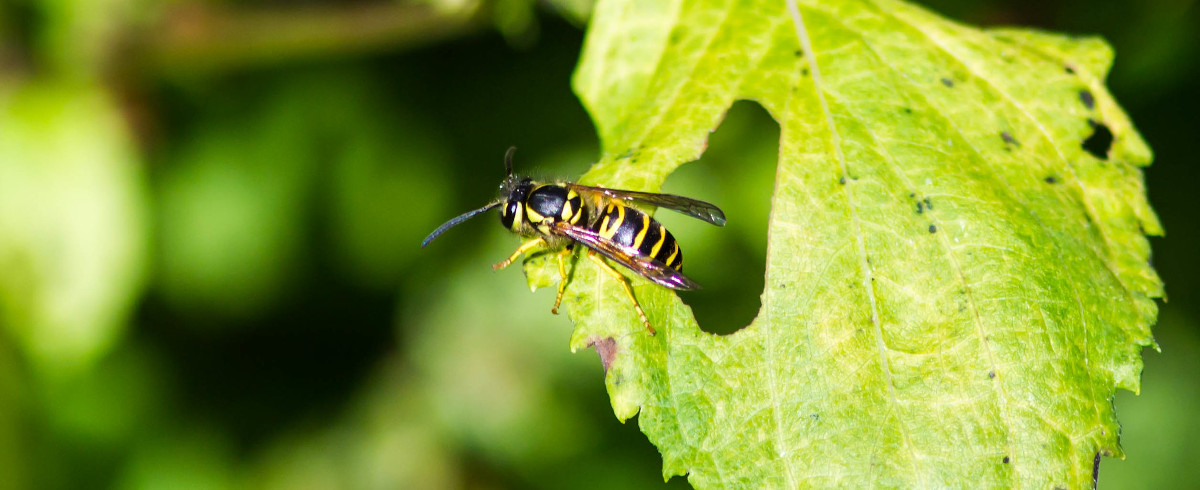 Photo by Melissa McMasters
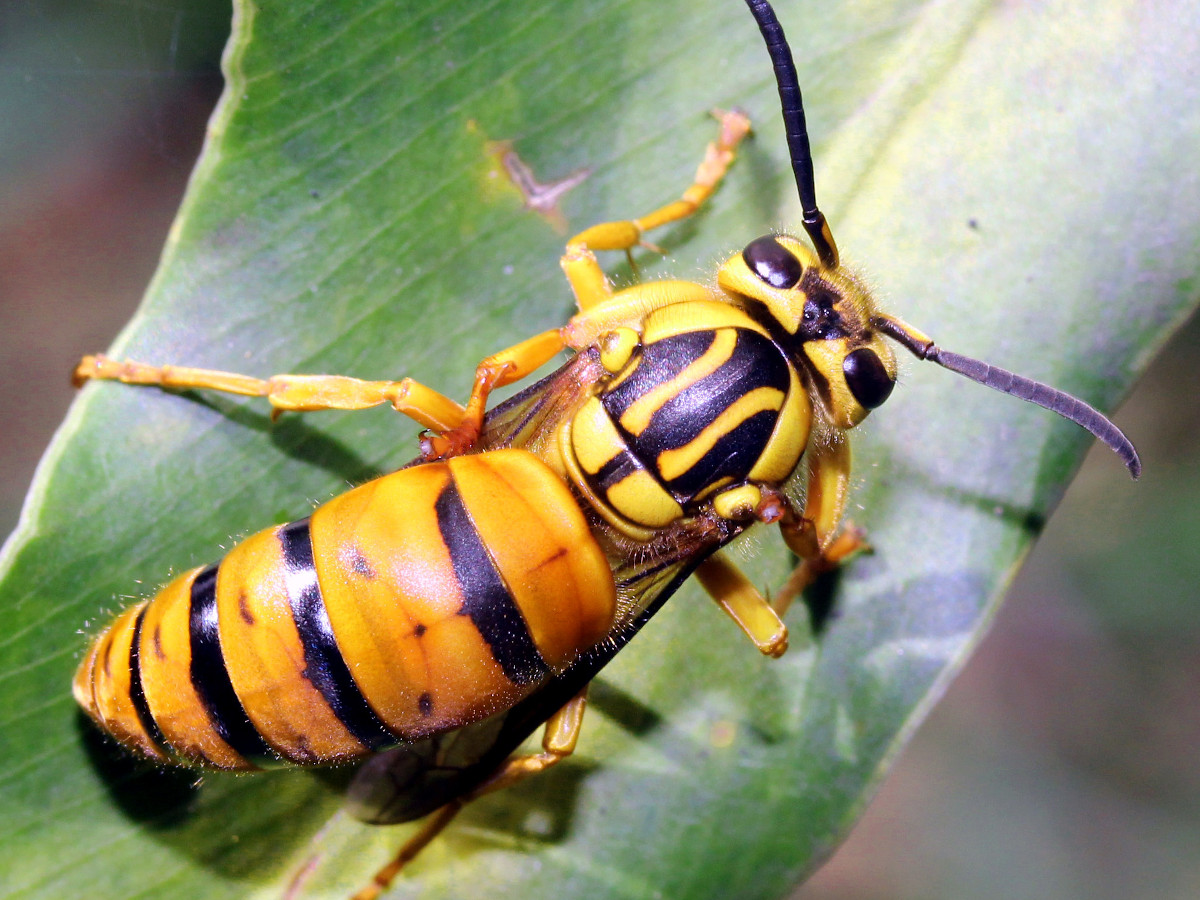
The 'yellow jacket' refers to the striking black and yellow markings all over the body of Vespula wasps. Their small size relative to other common wasps is also a quick identifier of yellowjackets. Worker females and males are a half inch in length with a black body and bright yellow markings on the head, thorax, abdomen and legs. The wings are clear and the body is not hairy. If you see an insect that matches most of this description but has a hairy body, you've likely encountered a bee rather than a yellow jacket.
Several Vespula and Dolichovespula species are common across the United States, and which one you encounter depends largely on your region. The four species below account for the overwhelming majority of yellow jacket encounters homeowners report, from the East Coast to the Pacific Northwest.
Southern Yellowjacket Wasps
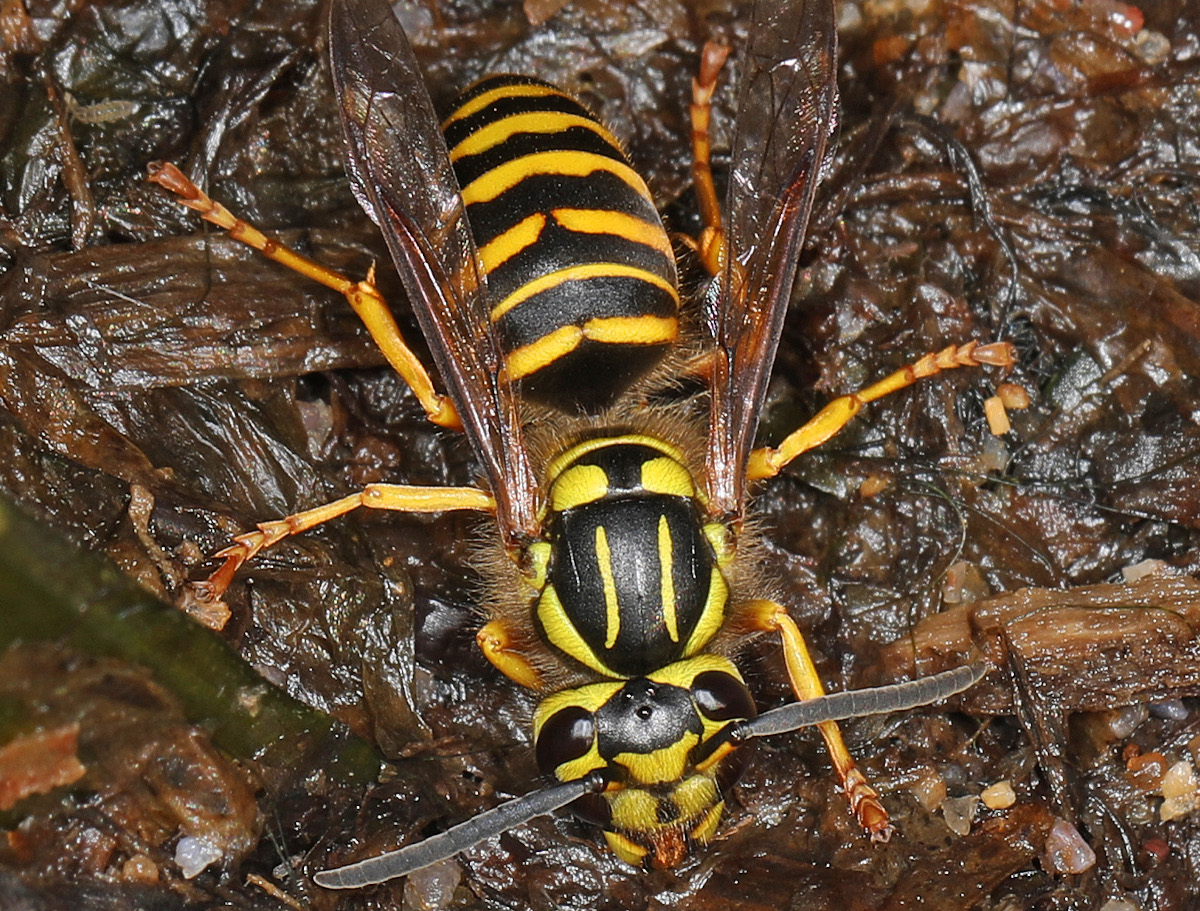 Photo by Judy Gallagher
The southern yellowjacket (Vespula squamosa) ranges from eastern North America all the way to Guatemala. Queens are noticeably larger (about ¾ inch in length) and orange in color. Southern yellowjacket colonies contain anywhere from 500-5,000 insects at their peak, with activity from early spring through November.
Eastern Yellowjacket Wasps
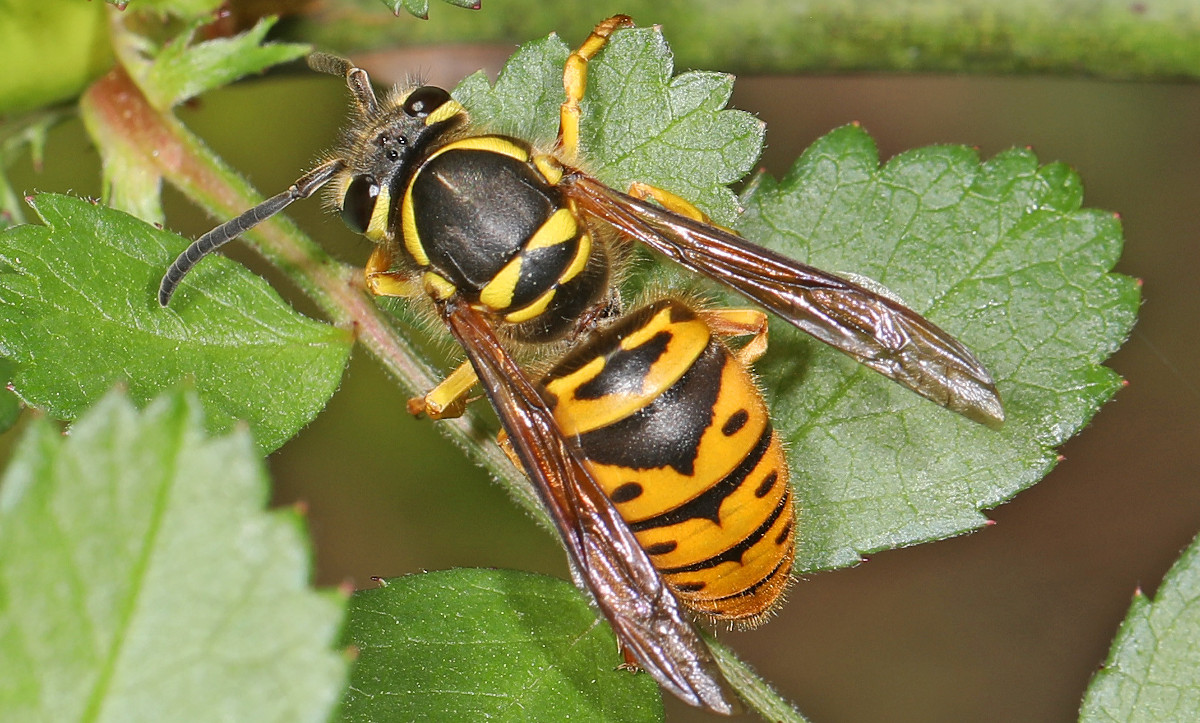 Photo by Judy Gallagher
The eastern yellowjacket (Vespula maculifrons) is native to the great plains and eastern North America. It is similar in size to the southern yellowjacket, but there are distinctive markings on the abdomen. The lines on the abdomen differ based on a caste system of workers, males and the queen. The abdomens of workers and males have thick black bands with three points on each one. Queens have one flared black line near the thorax followed by thin black lines. They also have two black dots between each black line on the abdomen.
Western Yellowjacket Wasps
The western yellowjacket (Vespula pensylvanica) is the most common ground-nesting yellow jacket across the western United States, from the Rocky Mountains to the Pacific coast. Workers are about a half inch long with the classic black-and-yellow banding and a distinctive complete yellow eye ring (the yellow marking fully encircles each eye). Western yellowjackets build large underground nests — often in abandoned rodent burrows — and are responsible for the majority of late-summer sting incidents at picnics, campgrounds, and backyards throughout California, Oregon, Washington, and the Intermountain West. Like other Vespula, colonies die off each winter, though in the mild climate of coastal California some nests occasionally overwinter and grow into large “perennial” colonies with multiple queens. The species was also introduced to Hawaii, where the absence of a winter freeze makes those perennial colonies far more common — see our Hawaii wasps guide.
German Yellowjacket Wasps
The German yellowjacket (Vespula germanica) is an introduced European species now widespread across the northeastern and northwestern United States and southern Canada. It closely resembles the eastern yellowjacket but is distinguished by black spots or a black anchor-shaped mark on the abdomen and small black dots within the yellow bands. Unlike most native yellowjackets, German yellowjackets frequently nest inside structures — wall voids, attics, and crawl spaces — rather than underground, which makes them one of the species most likely to turn up as a wasp problem inside the house. They are aggressive nest defenders and, like the western yellowjacket, can form very large colonies. This is also the species people usually mean by “European wasp” — see the European wasp identification guide for how to separate it from the European paper wasp and European hornet.
Yellow Jacket vs Wasp: Key Differences Explained
A common question homeowners ask is whether yellow jackets are “true wasps.” The answer is yes — yellow jackets are a type of wasp, but they differ from other common wasps in important ways. When most people ask “yellow jacket vs wasp,” they’re typically comparing yellow jackets to paper wasps, since these are the two species homeowners encounter most often.
| Feature | Yellow Jacket | Paper Wasp | Mud Dauber |
|---|---|---|---|
| Body shape | Stocky, compact | Slender with long legs | Very slender waist |
| Body length | 0.5 inch | 0.75–1 inch | 0.75–1 inch |
| Coloring | Bright yellow and black | Variable (brown, red, yellow) | Blue-black or black |
| Nesting | Underground or enclosed | Open umbrella nest | Mud tubes on walls |
| Aggression | High — will chase intruders | Moderate | Low — rarely stings |
| Colony size | 500–10,000+ workers | 20–75 workers | Solitary |
| Sting risk | High near nest | Moderate | Very low |
| Flight pattern | Fast, direct | Legs dangle in flight | Erratic, searching |
Why Yellow Jackets Are More Dangerous Than Other Wasps
Yellow jackets are significantly more aggressive than paper wasps and account for the majority of serious wasp sting incidents in North America. Key reasons include:
- Larger colonies: A yellow jacket nest can house thousands of workers, versus a few dozen for paper wasps
- Enclosed nests: Because their nests are hidden underground or in walls, homeowners often stumble onto them accidentally
- Alarm pheromones: When a yellow jacket stings or is crushed, it releases chemicals that trigger nearby workers to attack
- Late-summer aggression: By August and September, colonies are at peak size and food sources are scarcer, making yellow jackets especially defensive
For a detailed side-by-side breakdown, see our Yellow Jacket vs Wasp Complete Identification Guide. Because paper wasps are the species most often confused with yellow jackets, we cover that pairing in depth in our paper wasp vs yellow jacket identification guide.
Yellow Jacket vs Hornet: What’s the Difference?
Hornets and yellow jackets are both in the family Vespidae, but they belong to different genera. Yellow jackets (Vespula) are noticeably smaller than true hornets (Vespa), and their nests look different too. The most common “hornet” homeowners encounter in North America — the bald-faced hornet — is actually a yellow jacket relative (Dolichovespula maculata), not a true hornet.
| Feature | Yellow Jacket | Bald-Faced Hornet | European Hornet |
|---|---|---|---|
| Size | 0.5 inch | 0.75 inch | 1–1.5 inches |
| Coloring | Yellow and black | Black and white | Yellow, brown, black |
| Nest location | Underground or enclosed | Aerial (trees, eaves) | Trees, walls |
| Nest material | Gray paper | Gray paper | Brown paper |
| Aggression | High | Very high | Moderate |
People often try to sort all three of these black-and-yellow insects out at once. If you’re weighing a wasp vs hornet vs yellow jacket — for example, you’ve spotted a stinging insect but aren’t sure which of the three it is — our wasp vs hornet vs yellow jacket identification guide breaks down size, color, nest type, and aggression side by side. For just the two-way hornet comparison, see our hornet vs wasp identification guide, and to rule out a bee, see the bee vs wasp vs hornet guide.
Yellow Jacket vs Bee: Don’t Kill the Wrong Insect
More homeowners misidentify yellow jackets as bees than as any other insect, and the mistake matters in both directions — bees are protected pollinators worth leaving alone, while a yellow jacket colony near a doorway is a genuine hazard. The single fastest test is hair: yellow jackets are smooth and shiny, bees are visibly fuzzy.
| Feature | Yellow Jacket | Honey Bee | Bumblebee | Ground-Nesting Bee |
|---|---|---|---|---|
| Body | Smooth, glossy, hairless | Fuzzy, golden-brown and black | Very fuzzy, large and round | Fuzzy, often dark or metallic |
| Waist | Sharply pinched | Slightly narrowed | Barely visible | Slightly narrowed |
| Color | Bright lemon-yellow and black, crisp bands | Amber, brown, and dull yellow | Black with yellow or orange bands | Variable; often dull |
| Pollen | Never carries pollen | Yellow pollen baskets on hind legs | Pollen baskets on hind legs | Pollen on legs or belly hairs |
| Sting | Repeatedly, smooth stinger | Once — barbed stinger tears free and the bee dies | Repeatedly, but very reluctant | Repeatedly, but almost never does |
| Social structure | Colony of 500–10,000+ | Colony of 10,000–60,000 | Colony of 50–400 | Solitary — one female per burrow |
| Peak season | August–October | April–September | April–September | March–May |
| Interest in your food | Strong — meat, soda, fruit | None | None | None |
Ground bees vs yellow jackets is the comparison that trips people up most, because both come out of holes in the lawn. The tells are reliable:
- Many small holes scattered across a patch of bare soil, each with one fuzzy insect coming and going → solitary mining bees. They’re harmless, they’re done by June, and they need no treatment at all.
- One hole with a steady two-way stream of smooth wasps, busiest in late summer → a yellow jacket colony.
- A neat, round hole with a fan of excavated soil and one very large wasp → most likely a cicada killer or another solitary digger wasp, not a yellow jacket.
One more look-alike worth knowing: hoverflies (syrphid flies) mimic yellow jacket coloring almost perfectly but have two wings instead of four, huge fly-like eyes, stubby antennae, and a habit of hovering motionless in mid-air. They cannot sting at all.
For a full walkthrough of every stinging-insect look-alike, see our bee vs wasp vs hornet guide and wasp identification guide. Yellow jackets do visit flowers for nectar and provide incidental pollination — see do wasps pollinate — but they carry no pollen loads and are not a substitute for bees.
Yellow Jacket Nests
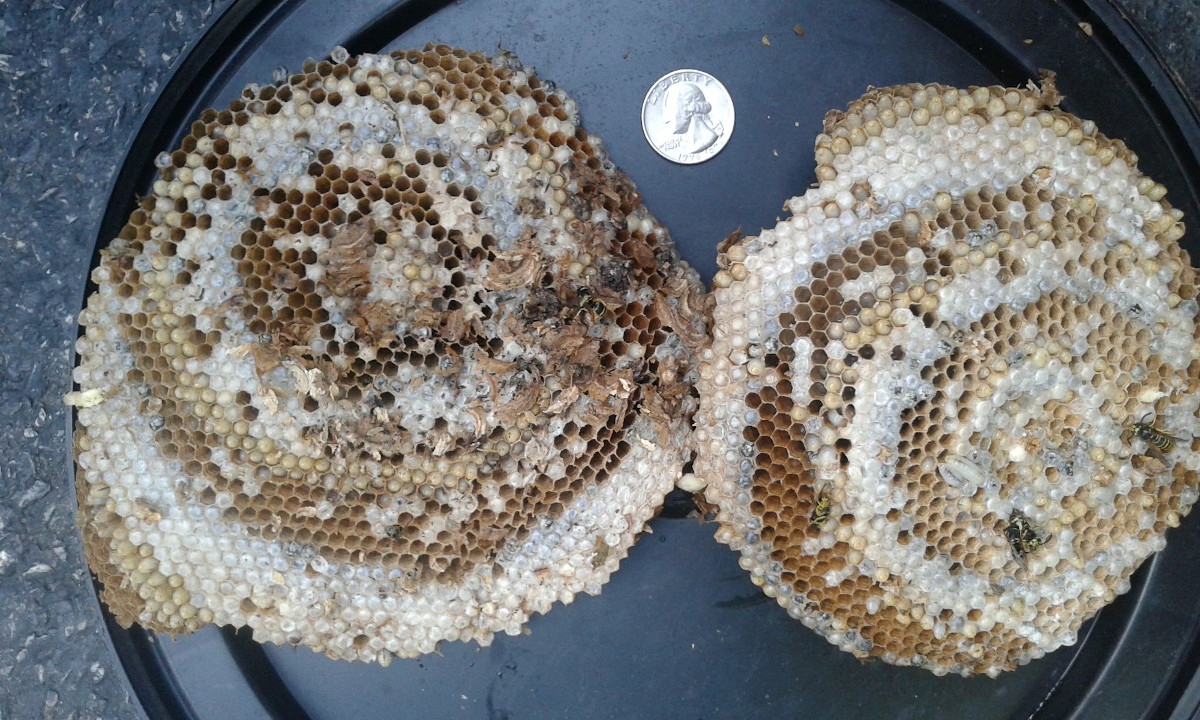 Photo by Praxis
Nest disturbances are the cause of almost all yellowjacket stings. For a nest-focused walkthrough — reading entrance traffic, locating a nest you can’t see, seasonal growth, and the leave-it-or-treat-it decision — see our yellow jacket nest identification guide.
Nests are most often constructed underground in networks of tunnels with cells for raising larvae (young wasps). Occasionally, nests are located in trees, walls or other indoor locations sheltered from the elements. They are constructed of chewed cellulose (plant fiber) glued together with wasp saliva to create elaborate structures of layered architecture, not unlike a multi-level apartment. Nests can have over 10,000 cells. Each cell is ultimately for raising young. Usually, nests are only used for one year, but in warmer climates nests can be used for several years.
Yellow Jacket Nest vs Paper Wasp Nest: How to Tell Them Apart
Identifying which type of nest you have changes your removal strategy significantly:
Yellow jacket nests:
- Usually hidden — underground, inside walls, or in dense vegetation
- Entrance is a small hole or gap, often hard to spot
- Paper exterior is gray and layered, with cells fully enclosed
- You’ll see many wasps flying in and out of a single entry point
Paper wasp nests:
- Openly visible — attached to eaves, fences, branches
- Honeycomb-like structure with visible cells (no paper covering)
- Umbrella or fan shape, typically smaller than yellow jacket nests
- Usually fewer than 30–75 wasps
If you see wasps disappearing into the ground or a wall void, assume yellow jackets and use caution. Nest identification isn’t as simple as with the Paper Wasp or Mud Dauber, but you will typically see a hole in the ground, a tree, or a wall with many wasps flying in and out of it during the day.
Natural History and Life Cycle
Yellowjackets are social insects with fascinating biology. They have a distinct caste system of sterile workers, females, males and a queen. A new colony is started by a single queen at the start of the warm season. For a complete guide to queen wasp identification, size, and lifecycle, see our queen wasp guide.
Spring: Colony Founding (April–May)
A mated queen that overwintered alone emerges when temperatures consistently reach 50°F or higher. She selects a nest site, builds a small paper comb, and lays the first eggs. After feeding on other insects and flower nectar, she raises the first generation of workers herself. This founding period is when yellow jacket colonies are smallest and least aggressive.
Summer: Rapid Growth (June–August)
Once worker wasps are fully on the job, the queen remains in the nest and relies on the workers for survival. Larvae are fed caterpillars, other insects, and protein-rich scraps. By midsummer, the nest can hold hundreds of workers. By late summer, a mature nest may contain 1,500–5,000 workers in colder climates, and up to 10,000+ in warmer regions.
Late Summer–Fall: Peak Aggression (August–October)
Late in the summer, workers construct larger reproductive cells in which male and female wasps are produced. They soon leave the nest and mate. As natural food sources diminish, workers become more aggressive foragers around human food. This is when most sting incidents occur. The queen then finds a hibernation site while males swarm in high numbers over hilltops and vegetation.
Winter: Colony Die-Off
Unlike honey bees, yellow jacket colonies do not survive winter. Workers and the old queen die with the first hard freezes. Only newly mated queens survive, tucked into protected spots under bark or leaf litter. Old nests are never reused, though new queens may build near the same location.
 Southern Yellowjacket Queen. Photo by David Hill
Southern yellowjacket queens are known to steal functioning nests from other species of yellowjackets. Because of this behavior, they are considered facultative social parasites. This means that they don't need to do this for survival, but parasitism is always an option for queens. In some areas of the deep south, up to 80% of southern yellowjacket nests show signs of parasitic origins.
Yellow Jackets in Fall: Why August Through October Is the Worst Time
If yellow jackets suddenly seem everywhere and far bolder than they were in June, nothing about your yard has changed — the colony’s biology has. Late summer and early fall is when nearly all yellow jacket sting incidents happen, and there are two specific reasons behind it.
Reason one: the colony is at maximum size. A nest founded by a single queen in April holds a few dozen workers by June. By late August the same nest may hold several thousand. Far more wasps are foraging, they’re ranging farther from the nest to do it, and a hidden nest that was easy to walk past all summer now has enough defenders to turn a lawn-mowing accident into a serious multiple-sting incident.
Reason two — the one most people have never heard of: the workers lose their sugar supply. Through spring and summer, adult workers hunt insects to feed the larvae, and in exchange the larvae secrete a sugary liquid that the adults drink. It’s a closed loop, and it’s the workers’ main carbohydrate source. In late summer the queen stops laying worker eggs, the last brood pupates, and that internal sugar supply simply ends. Thousands of adult wasps are suddenly hungry, out of a job, and searching for carbohydrates anywhere they can find them — which is your soda can, your trash bin, your fallen apples, and your picnic table.
What that looks like in practice:
- A shift from protein to sugar. Midsummer foragers want meat and insects. Fall foragers want anything sweet, and they become far more persistent about it.
- Scavenging around people. Yellow jackets that ignored you in July will land on a drink rim, crawl into an open can, or investigate food on a plate.
- Shorter fuse. Waving, swatting, and crushing all trigger alarm pheromones, and there are now thousands of workers within range to answer them.
- Wider search radius. Foragers routinely work several hundred yards from the nest, so heavy activity on your patio does not mean the nest is in your yard. See lots of wasps but no nest if you can’t find one.
- Males in the air. Newly produced males leave the nest to mate and gather over hilltops and vegetation. They cannot sting at all, but they add to the apparent numbers.
How to get through the fall season:
- Keep drinks covered and pour into a glass so you can see what’s inside — can stings to the mouth and throat are a real emergency risk.
- Use sealed trash and recycling bins, and rinse anything sugary before it goes in.
- Pick up fallen fruit under apple, pear, and plum trees; fermenting fruit is a magnet.
- Don’t swat. Walk away calmly. A crushed wasp releases the alarm pheromone that recruits others.
- Scout before you mow or trim. Watch a suspect patch of lawn for 60 seconds from a distance before running equipment over it — vibration is the most common trigger for ground-nest attacks.
- Trap on the perimeter, not the patio (see the trap section below).
When does it end? Activity falls off sharply once daytime highs stop clearing about 50°F — see what temperature do wasps stop flying — and the colony dies outright at the first hard freeze. In the northern US that’s usually late October or November; in the Gulf South and coastal California, foraging can continue into December. Only next spring’s mated queens survive, tucked under bark and leaf litter, and they don’t defend anything. For how activity shifts hour by hour and month by month, see when are wasps most active.
Are Yellowjacket Wasps Dangerous?
Yellowjackets sting when provoked (and it hurts)
These wasps are known for aggressively defending their nests. The good news is that they rarely sting when scouting or feeding on nectar at picnics and other outdoor activities.
Most swarms of stinging workers occur during attempted nest removals. Stings are intensely painful, and inflammation, fatigue and itching last for hours afterward. If symptoms get worse rather than improving after the first few hours following a sting, seek medical treatment as an infection may be occurring. While infections are extremely rare, anaphylactic allergic reactions occur in 4 out of 1,000 children. Symptoms include trouble breathing and swallowing and hives within two hours of the sting.
Yellow Jacket Sting: What to Expect
Unlike honey bees, yellow jackets do not leave their stinger behind and can sting multiple times. A single yellow jacket can sting repeatedly, and because of alarm pheromones, nearby workers will quickly join the attack if threatened. Key sting facts:
- Pain intensity: Sharp, burning sensation — rated more painful than paper wasp stings
- Multiple stings: Yellow jackets can and do sting repeatedly without dying
- Venom: Injected venom causes local swelling, redness, and pain lasting several hours
- Allergic risk: About 2% of adults have an allergic reaction; anaphylaxis is rare but life-threatening
Yellow Jacket Sting Treatment
For most people, home treatment is sufficient:
- Leave the area immediately — don’t swat, which triggers more stings
- Wash the sting site with soap and water
- Apply ice wrapped in a cloth for 20 minutes to reduce swelling
- Take an antihistamine (diphenhydramine/Benadryl) to reduce itching and mild allergic response
- Use ibuprofen or acetaminophen for pain relief
Seek emergency care if you experience: difficulty breathing, throat tightening, rapid heartbeat, dizziness, or hives spreading beyond the sting site. These are signs of anaphylaxis and require an epinephrine injection immediately. For the full pain and swelling timeline, step-by-step first aid, guidance on multiple stings, and how to tell a large local reaction from an infection, see our dedicated yellow jacket sting guide. For treatment across all wasp species, see our Wasp Sting Treatment Guide, and can wasps sting more than once for why a yellow jacket’s smooth stinger works so differently from a honey bee’s barbed one.
What to Do If You Disturb a Yellow Jacket Nest
Most serious sting incidents start the same way: someone mows, rakes, or steps on a ground nest they never knew was there. What you do in the next ten seconds determines whether you take two stings or twenty.
- Leave immediately and keep going. Don’t stop to look, don’t swat, and don’t try to assess the situation. Every second in the defensive zone adds stings.
- Run in a straight line, away from the nest. Yellow jackets will pursue an intruder well past the nest itself — commonly 50 to 100 feet, and farther if you keep provoking them. Cover your face and eyes with your hands or shirt as you go.
- Get inside a building or a vehicle and shut the door. A handful of wasps may follow you in; deal with those afterward, one at a time, with a fly swatter or by opening a window.
- Don’t jump in the pool or a pond. Yellow jackets hover above the surface and resume stinging the moment you come up for air. This advice appears constantly online and it is wrong.
- Change clothes and shower once you’re safe. Alarm pheromone clings to fabric and skin and can attract fresh attention if you go back outside.
- Count the stings. A healthy adult can tolerate a surprising number, but roughly 10 or more stings in a child, or a very large number in an adult, warrants a call to a doctor even without an allergic reaction.
Call 911 immediately for any sign of anaphylaxis — trouble breathing or swallowing, throat or tongue swelling, hives spreading away from the sting sites, dizziness, or fainting — or for stings inside the mouth or throat, which can swell enough to close the airway regardless of allergy status.
Afterward: mark the nest location from a safe distance so nobody repeats the accident, and don’t go back to the area that day. A disturbed colony stays agitated for hours. Plan any treatment for well after dark, following the steps in the next section, or hand it to a professional.
How To Get Rid of Yellow Jackets and Remove Their Nests
Yellow jackets are the most dangerous common wasp to remove yourself, because their colonies are large, hidden, and quick to swarm. Before doing anything, decide whether the nest actually needs to be treated at all.
Step 1: Decide Whether to Treat or Leave It
If a nest is well away from areas you and your family use — the back corner of a large yard, a fence line, a wood lot — the safest and most eco-friendly choice is often to leave it alone and mark the area with a stake or warning sign. Yellow jackets are valuable predators of garden pests, and every colony dies off naturally after the first hard freeze in late fall (typically November–December). Once the colony is dead, an abandoned in-ground nest can simply be plugged with soil to discourage a new queen from choosing the same spot next spring.
Treatment becomes worthwhile when the nest is near a door, walkway, patio, play area, or anywhere people pass within about 15 feet — or if anyone in the household is allergic to stings.
Step 2: Treat at Night or Pre-Dawn, From a Distance
Timing is the single most important safety factor. Yellow jackets are diurnal, so nearly the entire colony is home and sluggish after dark. Treat about two hours after sunset or in the 30 minutes before sunrise, when cool temperatures slow the wasps and low light keeps them from pursuing you. Never treat a nest in the middle of the day — see what time do wasps go to their nest for the full hour-by-hour breakdown and flashlight precautions.
- Commercial wasp & hornet jet spray (most reliable DIY option). Choose a product rated for 15–20 feet so you can treat from well outside the colony’s defensive zone. Pyrethroid-based sprays kill on contact and leave a residue that continues killing returning foragers for days. Apply a long burst directly into the entrance hole, then walk (don’t run) to a pre-planned exit. Reassess after 24 hours and re-treat if wasps are still entering and exiting. See our wasp spray complete guide and the does Raid kill wasps comparison for product selection. Skip household improvisations like WD-40 — they are flammable, short-range, and leave no residue.
- Insecticidal dust. For ground and wall-void nests, a labeled wasp dust puffed into the entrance is often more effective than liquid spray because workers track it deep into the nest. Apply at night wearing full protective clothing.
For underground colonies specifically, our ground wasps removal guide and wasps that live in the ground cover entry-hole treatment in detail, and our underground wasp nests guide explains what you’re dealing with below the surface.
Earth-Friendly (Non-Chemical) Options
For accessible ground nests where you prefer to avoid insecticide, two lower-toxicity methods can work — though both put you closer to the nest and carry more risk than a long-range spray:
- Soap and water — Mix a few tablespoons of dish detergent per gallon of water. At dusk or dawn, pour the solution directly into the entrance hole; the soap coats the wasps and blocks their breathing pores, and the water floods the tunnel. A quick, heavy pour followed by an immediate retreat works best.
- Diatomaceous earth — This crushed-silica powder is harmless to touch but lethal to insects’ exoskeletons. Dust it around and into the entrance hole at dusk while wearing long sleeves, gloves, and eye protection. It must be reapplied after rain.
Avoid the dangerous folk remedies: never pour gasoline or other flammable liquids into a nest, and never seal a wall-void entrance without treating the colony first — trapped wasps will chew new exits, sometimes into your living space.
Step 3: Know When to Call a Professional
Call a licensed pest control professional if any of the following apply:
- The nest is inside a wall void, attic, or crawl space (common with German yellow jackets)
- The nest is large or high up, or you can’t identify a single entry point
- Previous DIY treatment didn’t fully eliminate the colony
- Anyone in the household has a heart condition or a known bee/wasp venom allergy
A single professional yellow jacket treatment typically runs about $150–300 and eliminates the colony with essentially no risk to you — usually far less than the medical cost of a multiple-sting incident. For a full comparison of methods, timing, and equipment, see our complete wasp nest removal guide and wasp nest removal safety guide. If yellow jackets are already getting indoors, see how to get rid of wasps in the house.
Keep Yellowjackets Away
Garbage cans can be attractive to foraging yellowjacket wasps. It's important to keep all garbage receptacles closed when not in use.
Other prevention strategies:
- Keep outdoor food and drinks covered at picnics and cookouts
- Pick up fallen fruit from trees — yellow jackets are attracted to fermenting sugars
- Avoid wearing sweet perfumes or bright floral clothing during peak season (August–September)
- Inspect your yard for ground holes in early spring before colonies grow large
- Seal gaps in siding, soffits, and foundations where wasps could establish wall nests
Scent-based deterrents — peppermint, clove, and lemongrass oils in particular — can make a patio or doorway less appealing, though they wash off and need reapplying. See what smell do wasps hate and how to keep wasps away for mixing ratios and placement.
Do Yellow Jacket Traps Work?
Yes, but only for the problem they actually solve: reducing the number of foragers in a specific outdoor space. A trap will never eliminate a colony, because it catches workers out foraging and never touches the queen or the brood. Judge a trap by whether your patio is usable, not by whether the wasps are gone.
What makes traps work:
- Match the bait to the season. Protein baits (a scrap of raw chicken, canned cat food, lunch meat) pull foragers in spring and early summer. Sugar baits (fruit juice, soda, jam and water, a splash of vinegar to keep honey bees out) work far better from midsummer on, once the colony’s internal sugar supply collapses.
- Place them on the perimeter, not next to you. Traps attract wasps. Hang them 20 to 30 feet upwind of the patio, deck, or play area you’re protecting — putting one on the picnic table draws wasps straight to the food.
- Start early. Traps set out in spring catch founding queens, and each queen removed is a colony that never happens. A trap deployed in September is pure damage control.
- Maintain them. A trap full of dead wasps and fermented bait stops catching. Empty and rebait weekly.
- Use enough of them. One trap on an acre accomplishes very little; a line of them along a property boundary makes a noticeable difference.
What traps won’t do: clear an active nest, protect an unprotected picnic already underway, or work at all if a better food source (an open trash bin, fallen fruit) is competing nearby. Fix the competing attractant first.
Commercial traps baited with heptyl butyrate are worth knowing about in the western US — the chemical is highly attractive to western yellowjackets and, usefully, not attractive to honey bees. Eastern and German yellow jackets respond poorly to it and do better with conventional food baits.
For builds, bait recipes with exact ratios, and placement strategy, see our homemade wasp trap guide and the complete wasp trap guide.
What Attracts Yellow Jackets to Your Yard?
Yellow jackets are drawn to your property by food, water, and shelter. Understanding what attracts them helps you reduce encounters before colonies grow large.
Food and drink:
- Sweet beverages — Open soda cans, juice, beer, and sports drinks are major attractants. Yellow jackets can enter a can and sting from inside.
- Protein sources — Outdoor grilling, pet food left outside, and open garbage cans attract foraging workers, especially in late summer when natural prey is scarce.
- Fallen fruit — Rotting or fermenting fruit beneath apple, pear, and plum trees is a prime yellow jacket food source in late summer.
- Hummingbird feeders — The sugar water attracts yellow jackets; use feeders with bee guards and keep them clean.
Water:
- Swimming pools, bird baths, and dripping irrigation lines provide the moisture yellow jacket colonies need in summer heat.
Shelter opportunities:
- Gaps in siding, soffits, and foundation walls are entry points for wall nests.
- Abandoned rodent burrows in lawns are ready-made nest sites — yellow jackets move in without digging.
- Wood piles and dense shrubs close to the house create nesting habitat.
What doesn’t attract yellow jackets:
- Unlike bees, yellow jackets are not primarily attracted to flowers for pollen. They visit flowers for nectar but are far more interested in your food than in your garden.
- Bright colors don’t attract them the way they attract bees, but quick movements and vibrations (mowers, weed trimmers) near nests trigger defensive attacks.
For a complete prevention guide, see how to get rid of wasps in your house and how are wasps getting in my house.
Facts About Yellowjackets
- Nest architecture can be studied to determine if a yellowjacket wasp has parasitic origins. New additions of a nest can be built in very different architectural styles.
- Yellowjackets release alarm pheromones that send chemical signals to other worker wasps in the event of a threat to the nest, enabling swarm behavior. Venom glands on the head and stomach release the pheromones.
- The largest nests in Texas were over 6 feet across, but even larger nests have been studied in Florida.
- Yellowjackets and many other wasps are rare examples of parental care in insects. Larvae are carefully raised and protected in the cells within the nest as they are fed insect prey until pupation.
- Southern yellowjackets (Vespula squamosa) are polygynous with more than one queen occupying a nest. Other species have one queen per nest. Scientists are not sure what the benefit of polygyny is for these wasps.
- There are at least 28 species in the Vespula genus, but scientists suspect there may be more species yet to be discovered by science. There's even a distinct population of southern yellowjackets in the mountains of Mexico that may someday be declared a distinct species.
- The 410,000 acre Ranch Fire that burned Northern California in 2019 was started by a rancher plugging an underground wasp nest. Sparks flew as a metal stake was hammered into the ground.
Frequently Asked Questions About Yellow Jackets
Is a yellow jacket a wasp or a bee?
A yellow jacket is a wasp, not a bee. Yellow jackets belong to the genus Vespula in the family Vespidae, which makes them true wasps. They are often confused with bees because of their yellow-and-black coloring, but key differences make them easy to tell apart once you know what to look for: yellow jackets have smooth, hairless bodies; bees are fuzzy. Yellow jackets have a narrower, more defined waist; bees are more rounded. Yellow jackets can sting repeatedly without dying; honey bees die after their first sting.
Do yellow jackets come back to the same nest?
No. Yellow jacket nests are abandoned every fall when workers and the old queen die with the first hard freezes. Old nests are never reused the following year. However, new queens may choose a nearby location — under the same eave or near the same burrow — to start a fresh nest in spring. If you find a nest in late fall or winter, it’s safe to remove and dispose of the empty paper structure to discourage queens from nesting in the same spot.
Do yellow jackets make honey?
No. Yellow jackets do not produce honey. They feed their larvae on proteins (insects, meat, caterpillars) and adult workers consume carbohydrates (nectar, fruit juices, sugary human food), but they store no food reserves in their nests. This is why yellow jackets become more aggressive scavengers in late summer — as natural food dwindles, workers forage more desperately around human food sources.
Can yellow jackets sting more than once?
Yes — repeatedly. Unlike honey bees, yellow jackets have smooth stingers that don’t detach from their bodies. A single yellow jacket can sting you multiple times in one encounter. More dangerously, a stinging yellow jacket releases alarm pheromones that signal nearby workers to join the attack. This is why disturbing a ground nest can quickly result in dozens of stings.
When do yellow jackets go away?
Yellow jackets become inactive after the first sustained hard freezes in fall, typically between October and December depending on your region. Workers and the original queen all die by winter. Only newly mated queens survive, hibernating in protected spots. By January or February in most of the US, yellow jacket activity has completely stopped for the season. Activity resumes in April or May when overwintering queens emerge to start new colonies.
Are yellow jackets beneficial?
Yes, despite their aggression. Yellow jackets are significant predators of caterpillars, flies, and other pest insects, providing natural pest control in gardens and agricultural areas. A mature colony can consume tens of thousands of pest insects per season. They also provide some incidental pollination when foraging for nectar. The ecological trade-off: their benefits occur across the entire landscape, while their sting risk is concentrated near the nest. Nests far from human activity are generally worth leaving alone.
What is the difference between a yellow jacket and a paper wasp?
The quickest way to tell them apart: yellow jackets are compact and stocky with bright yellow-and-black banding; paper wasps are slender with long legs that dangle during flight and are often brown, red, or duller yellow. Yellow jackets build hidden nests underground or in wall voids; paper wasps build visible open umbrella-shaped nests under eaves. Yellow jackets are much more aggressive and will chase intruders far from the nest; paper wasps only defend when you approach their nest closely. See our complete Yellow Jacket vs Wasp guide for a full comparison.
How far will yellow jackets chase you?
Farther than most people expect. Workers defending a disturbed nest commonly pursue an intruder 50 to 100 feet, and they’ll keep going if you continue to swat or flail. Run in a straight line away from the nest, cover your face, and get indoors or into a vehicle. Don’t jump into water — they simply wait above the surface.
How long do yellow jackets live?
Workers live roughly two to three weeks as adults. Males live only long enough to leave the nest and mate in the fall. Queens are the exception: a mated queen lives about a year, spending the winter in hibernation and dying the following autumn after her colony has produced the next generation of queens.
Why are yellow jackets so aggressive in the fall?
Two things happen at once. The colony reaches its maximum size — thousands of workers instead of dozens — and the larvae that supplied the adult workers with sugar stop being produced. Thousands of hungry adults go looking for carbohydrates at exactly the moment there are the most of them, which is why late summer and early fall produce nearly all yellow jacket sting incidents.
What smells do yellow jackets hate?
Strong aromatic oils — peppermint, clove, lemongrass, eucalyptus — and vinegar all discourage foraging yellow jackets from settling on a surface. They’re genuine deterrents for a patio or doorway, but they wash off in rain and will do nothing to an established nest. See what smell do wasps hate for recipes.
Are yellow jackets active at night?
Barely. Yellow jackets are diurnal, and after dark essentially the whole colony is home and sluggish, which is exactly why nest treatment is a nighttime job. They can still respond if you shine a bright light directly at the entrance — use a red-filtered light or set a flashlight off to one side. See what time do wasps go to their nest.
Can yellow jackets sting through clothing?
Through thin, tight-fitting fabric, yes — a single layer of t-shirt or leggings offers little protection. Loose clothing and heavier fabric like denim or canvas are much better. This is why long sleeves, tucked cuffs, and gloves matter if you’re treating a nest, and why a bee suit is the right call for anything larger than a small ground nest.
What should I do about a single yellow jacket in the house?
Don’t swat it in an enclosed space. Open a window or door, close interior doors to contain it, turn off the interior lights, and it will usually head for the daylight on its own. Repeated indoor sightings mean a nest in a wall void or attic — most often a German yellow jacket — and that’s a job for a professional. See how are wasps getting in my house.
Related Guides
- Yellow Jacket Sting: Pain, Symptoms & Treatment — what to expect, first aid, multiple stings, and emergency warning signs
- Yellow Jacket Wasp: Identification & Behavior Guide — in-depth species identification, colony behavior, and nesting patterns
- Yellow Jacket vs Wasp: Complete Identification Guide — detailed comparison of yellow jackets vs paper wasps and other common species
- Paper Wasp vs Yellow Jacket: Identification Guide — telling apart the two most commonly confused yard wasps
- Wasp vs Hornet vs Yellow Jacket: How to Tell Them Apart — three-way comparison of size, color, nests, and aggression
- Hornet vs Wasp: Complete Identification Guide — how true hornets differ from yellow jackets and other wasps
- Bee vs Wasp vs Hornet: Complete Identification Guide — distinguishing stinging insects, including fuzzy bees from smooth yellow jackets
- Do Wasps Sting or Bite? Treatment Guide — what to do if a yellow jacket stings you
- How Many Wasps Are in a Nest? — understanding colony sizes across species
- Are Wasps Aggressive? — why yellow jackets defend nests so fiercely
- Ground Wasps — other wasps that nest underground like yellow jackets
- Ground-Nesting Wasps and Bees — overview of all ground-nesting species in your yard
- Underground Wasp Nests: Complete Guide — identification and management of in-ground nests
- Paper Wasps — a less aggressive wasp species that builds open nests
- Mud Daubers — solitary, non-aggressive wasps with distinctive mud nests
- Bald-Faced Hornet: Complete Guide — the large black-and-white relative of yellow jackets with aerial paper nests
- Bald Faced Hornet Sting: Pain, Symptoms & Treatment — sting timeline, first aid, multiple-sting thresholds, and venom-in-the-eye first response
- Wasps in Grass — identifying and managing yellow jackets nesting in your lawn
- How Are Wasps Getting In My House? — yellow jackets and other species that invade wall voids and attics
- Wasp Trap Complete Guide — DIY and commercial traps, baits, and placement for late-season foragers
- Homemade Wasp Trap — bottle and bucket builds, seasonal bait recipes, and how to avoid catching honeybees
- What Smell Do Wasps Hate? — scent deterrents for patios, doorways, and eaves
- What Temperature Do Wasps Stop Flying? — when fall activity finally shuts down in your region
- When Are Wasps Most Active? — daily and seasonal activity patterns behind late-summer encounters
- Lots of Wasps But No Nest? — why heavy yellow jacket traffic doesn’t mean the nest is in your yard
More Yellow Jacket and Look-Alike Guides
- Ground Wasps in Texas — yellow jackets and other ground nesters in Texas lawns
- Ground Wasps in Florida — ground-nesting species Florida homeowners encounter
- Yellow Wasps in Texas — sorting yellow jackets from yellow paper wasps in Texas
- Yellow Wasps in Florida — regional guide to Florida’s yellow species
- Black and Yellow Wasps in Texas — regional identification by color pattern
- Black and Yellow Wasps in Florida — Florida’s black-and-yellow species compared
- Yellow and Black Wasps in Florida — narrowing down a Florida sighting
- Sand Wasp Identification — a banded solitary look-alike that nests in sand
- Digger Wasp Identification — solitary ground nesters often mistaken for yellow jackets