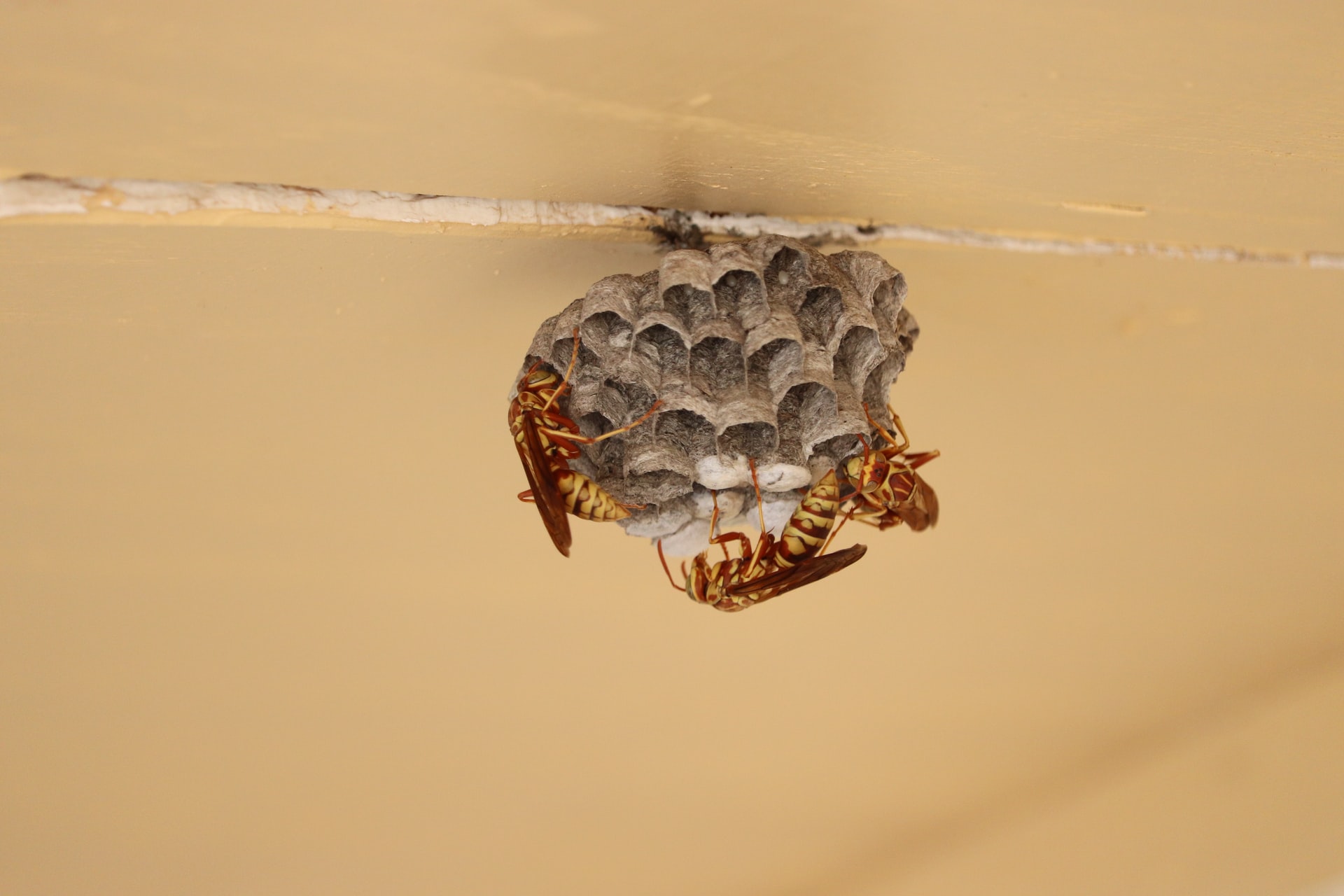
Paper wasps are slender, long-legged wasps that build distinctive open-celled, umbrella-shaped nests under eaves, porch ceilings, and tree branches. They belong to the genus Polistes, one of the most common wasp groups homeowners encounter across North America. Unlike the aggressive yellow jacket — which nests underground and pursues intruders far from the nest — paper wasps are relatively docile insects that sting only when you approach their nest closely or handle them directly.
Quick paper wasp facts:
- Size: 0.75–1 inch long; slender body with long legs that dangle during flight
- Color: Variable — yellow, brown, reddish, or orange depending on species
- Nest: Open honeycomb-style comb with visible cells; no paper covering; attached by a single stalk
- Danger level: Low to moderate; rarely sting unless nest is threatened directly
- Season: Active spring through fall; colonies die in winter; nests never reused
Paper wasps pollinate fruits and vegetables, and they eat garden pests like nuisance caterpillars. Even though these ancient insects are largely beneficial, sometimes they make their umbrella-shaped nest in an inconvenient spot. We'll take a look at some Earth-friendly ways of sending paper wasps on their way.
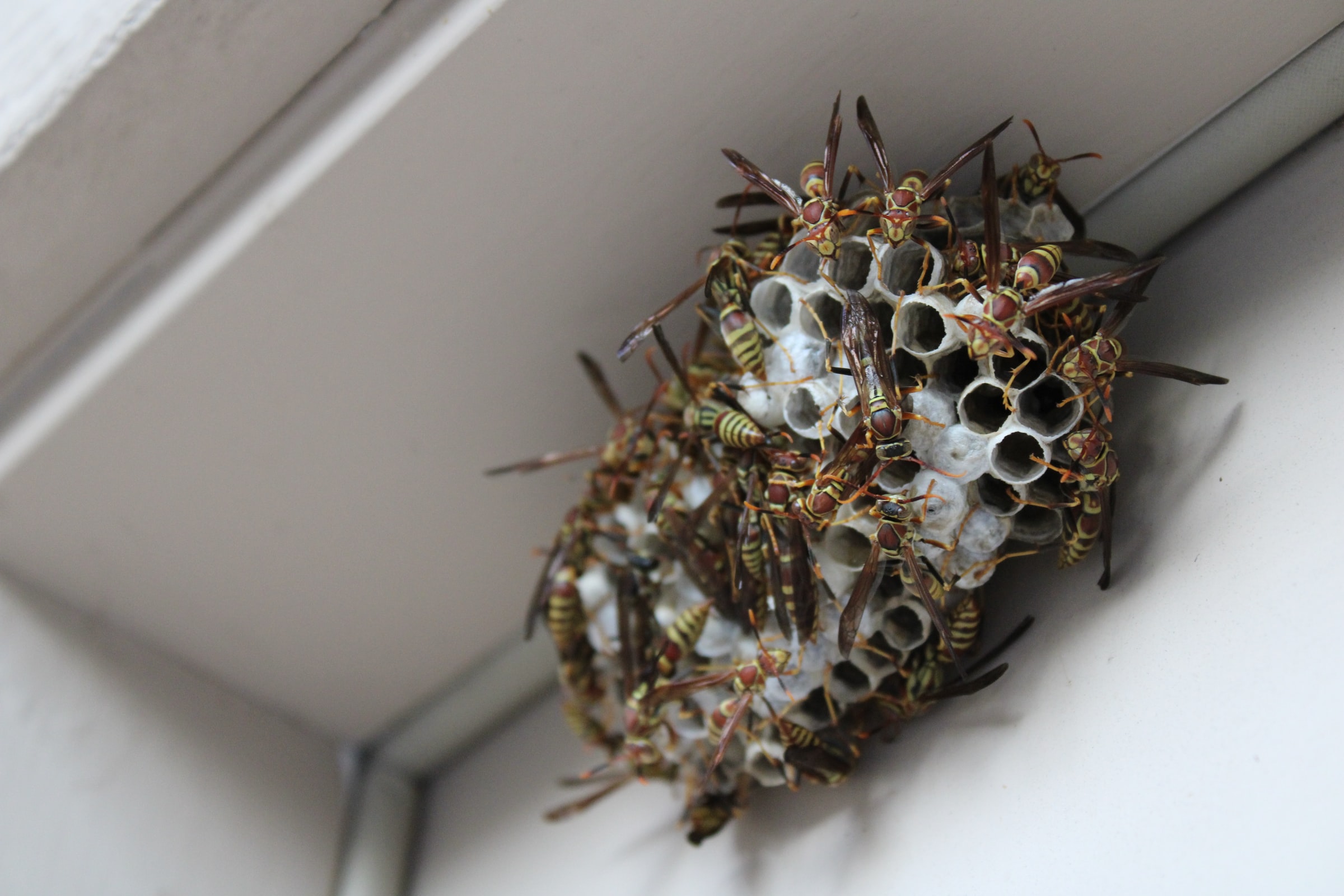
Identification
From afar, paper wasps look like long, skinny bees with large legs that dangle beneath them in flight. The most common paper wasps are about ¾ inch long, with some over 1 inch in length. Size, markings and color vary depending on the age and species. Most of the 24 species of the genus Polistes in the US are yellow or light brown with some red markings. The most common paper wasps in America are the northern paper wasp (Polistes fuscatus) and the European paper wasp (Polistes dominula). The European paper wasp is invasive, meaning that it was introduced to North America by humans. Recent research shows that these invasive wasps actually harm the survival of our native wasps, such as the northern paper wasp. Each species has a unique pattern of markings and nesting habits. For general paper wasps, the ID giveaway is their nests. They are considered social wasps, so they live together in a unique abode. The nests look like upside down brown paper combs, attached to a surface with a single stalk. They're also known as 'umbrella wasps' due to the umbrella-shaped structure of these upside-down nests.
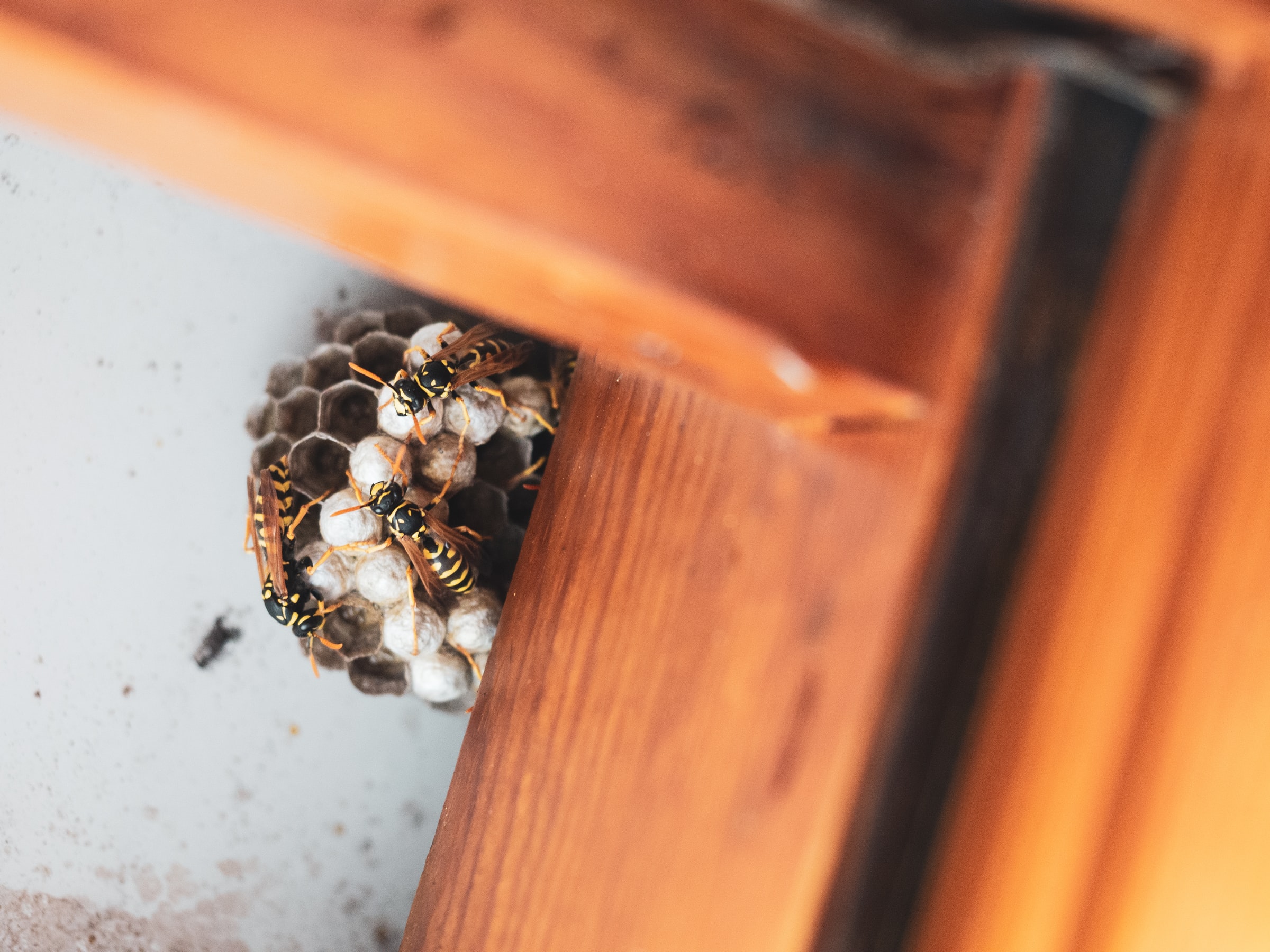
Common Paper Wasp Species in the United States
While there are 24 species of Polistes found in the US, three species account for the majority of homeowner encounters:
Northern Paper Wasp (Polistes fuscatus) — The most widespread native species, found across the eastern two-thirds of North America. Workers are 0.75–1 inch long with variable brown, yellow, and reddish markings. Colonies are relatively small (10–30 workers), and this species is considered low-to-moderate in aggression.
European Paper Wasp (Polistes dominula) — An invasive species introduced from Europe, now established across most of the US. Distinctive bright yellow and black banding makes it frequently confused with yellow jackets. It is highly adaptable and has expanded its range at the expense of native paper wasps.
Apache Paper Wasp (Polistes apachus) — The dominant paper wasp species across the southwestern United States, including Arizona, New Mexico, Texas, California, Nevada, and Oklahoma. Apache paper wasps are reddish-brown to orange in color with yellow facial markings, and are often mistaken for red wasps due to their similar coloration. They build the same characteristic open-cell umbrella nests as other Polistes species, typically under eaves, porch ceilings, and tree branches. Apache paper wasps are moderately defensive near their nests but are not considered highly aggressive when encountered away from the nest. In the southwestern US, “paper wasp” most often refers to this species specifically.
| Species | Region | Color | Aggression |
|---|---|---|---|
| Northern paper wasp | Eastern US | Brown/yellow/red variable | Low–moderate |
| European paper wasp | Nationwide | Bright yellow and black | Moderate |
| Apache paper wasp | Southwestern US | Reddish-brown/orange | Moderate |
| Red paper wasp (P. carolina) | Southeastern US | Deep red | Moderate–high |
Other Names for Paper Wasps
Because Polistes species vary so much in color from one region to the next, homeowners often know them by informal names rather than “paper wasp.” If you arrived here searching one of these, you’re in the right place:
- Umbrella wasp — a nickname for the whole genus, taken from the inverted-umbrella shape of the open comb. Any wasp called an umbrella wasp is a paper wasp.
- Brown wasp — usually the northern paper wasp (Polistes fuscatus), whose dark brown body carries only faint yellow markings.
- Mahogany wasp — an informal, regional name rather than an official one, applied to the reddish-brown paper wasps such as P. metricus and P. carolina.
- Red wasp — the standard Southern name for P. carolina and P. perplexus, both of them paper wasps. See our red wasp guide and the dedicated red paper wasp guide.
- Guinea wasp — Polistes exclamans, common across the southern and eastern US. See the guinea wasp guide.
- Black paper wasp — dark forms of P. fuscatus and P. metricus. Note that not every large black wasp is a paper wasp: the great black wasp and the bald-faced hornet are entirely different insects with different nests. Our black wasp identification guide sorts them out.
Not a paper wasp: “hornet” and “yellow jacket” are separate groups in the same family (Vespidae). Hornets and yellow jackets build enclosed nests with a paper shell; paper wasps never do. See Wasp vs Hornet vs Yellow Jacket if you’re unsure which of the three you have.
Paper Wasp Nests: Identification and What to Do
Paper wasp nests are among the easiest to identify of any stinging insect. Recognizing them early — before the colony grows large — means you have more options for safe removal.
What a paper wasp nest looks like:
Paper wasp nests are open, umbrella-shaped combs made from chewed wood fiber and wasp saliva. Unlike yellow jacket nests (which are enclosed with a paper outer layer), paper wasp nests expose their hexagonal cells directly. The individual cells face downward and are visible from below.
- Color: Gray to tan-brown, depending on the wood fibers used
- Shape: Round or fan-shaped; resembles an inverted umbrella or open honeycomb
- Size: Starts the size of a quarter in early spring; can reach 6–8 inches across by late summer
- Texture: Papery and lightweight; the surface has a slightly rough, papier-mâché appearance
- Attachment: Hangs from a single central stalk — no solid connection across the base
Where paper wasps build nests:
Paper wasps prefer sheltered, semi-shaded spots with morning sun. Common locations include:
- Under eaves, porch ceilings, and overhangs
- On deck railings, fence posts, and tree branches (typically 6–15 feet up)
- Inside sheds, garages, and barns — especially near the ceiling
- On window and door frames, especially ones that face south or east
- Occasionally on outdoor furniture, playground equipment, or downspout openings
Early vs. mature nests:
A spring nest (April–May) is the size of a grape or golf ball with 5–15 cells and a single queen. This is the safest time to act — a direct spray at night eliminates a one-wasp colony instantly. A mature summer nest (July–August) has 20–75 workers with a comb 4–8 inches across, requires more caution, and is best treated with a 15-foot standoff distance after dark. For step-by-step removal instructions, see our Paper Wasp Nest Identification and Removal Guide.
Active vs. abandoned:
Watch the nest for 10–15 minutes during daylight. An active nest always has wasps entering and exiting. A nest with no movement for 15 minutes may be abandoned — confirm by checking again the next morning. Empty winter nests are safe to remove at any time and pose no sting risk.
Paper Wasp vs Yellow Jacket: Key Differences
Paper wasps and yellow jackets look similar at a glance, but behave very differently — and the distinction matters for how you respond to them.
| Feature | Paper Wasp | Yellow Jacket |
|---|---|---|
| Body shape | Slender, long legs dangle in flight | Compact, rounded, legs not visible in flight |
| Body length | 0.75–1 inch | ~0.5 inch (noticeably smaller) |
| Coloring | Variable: yellow, brown, red, or orange | Bright yellow and black bands |
| Nest type | Open umbrella-shaped comb; cells visible | Enclosed gray paper nest; hidden underground or in walls |
| Colony size | 10–75 workers | 500–10,000+ workers |
| Aggression | Low–moderate; defensive near nest only | High; will chase intruders far from the nest |
| Scavenging | Rarely interested in human food | Actively seeks picnic food, drinks, and trash |
| Sting risk | Low if you don’t approach the nest | High, especially in late summer |
The quick test: If wasps are buzzing around your food or drinks at a picnic, they’re almost certainly yellow jackets. Paper wasps are insect predators — they’re not interested in your sandwich.
Why this matters for removal: Yellow jacket nests are usually hidden underground or inside wall cavities, making accidental disturbance very common. Paper wasp nests are openly visible under eaves or on branches, giving you more warning before you get too close. See our Yellow Jackets guide for more on the differences in nest removal strategy.
Paper Wasp Nest vs Yellow Jacket Nest
Telling the two nests apart is easier than telling the two insects apart — and it’s the faster way to identify what you’re dealing with, because you can do it from a safe distance.
The one-second test: can you see the cells?
A paper wasp nest is a single bare comb. Its hexagonal cells face downward and are fully exposed, so from underneath you are looking straight into the openings. A yellow jacket nest is wrapped in layers of gray paper envelope — you never see a cell from outside, only a smooth shell with one small entrance hole. If cells are visible, it’s a paper wasp nest. Every time.
| Feature | Paper Wasp Nest | Yellow Jacket Nest |
|---|---|---|
| Outer covering | None — comb is bare | Enclosed in a layered paper envelope |
| Cells visible? | Yes, from below | No, never from outside |
| Shape | Flat or slightly domed disc, like an inverted umbrella | Ball, football, or shapeless mass filling a cavity |
| Internal structure | One single comb | Several combs stacked in horizontal tiers |
| Attachment | Hangs from one thin stalk | Anchored broadly, or packed into a void |
| Typical location | Exposed under eaves, porch ceilings, railings, branches | Underground burrows, wall voids, attics, dense shrubs |
| Entrance | Open on all sides — wasps land anywhere on the comb | A single small hole with steady two-way traffic |
| Mature size | 3–8 inches across | Softball to basketball size or larger |
| Peak population | 10–75 workers | 500–5,000+ workers |
| Reused next year? | No | No |
Two things that trip homeowners up:
A new yellow jacket nest can look open. In late spring, before the envelope is complete, a founding yellow jacket queen’s first few cells may be briefly visible. The difference is location — that early nest is almost always tucked inside a cavity, burrow, or void, not hanging in the open air.
Not every enclosed aerial nest is a yellow jacket nest. The gray football-shaped nest hanging from a tree branch belongs to the bald-faced hornet, a close yellow jacket relative. It is enclosed like a yellow jacket nest but exposed like a paper wasp nest, and its occupants are considerably more defensive than either. For a full breakdown of enclosed aerial nests, see Hornet Nest vs Wasp Nest.
Why the distinction changes what you do: a paper wasp comb the size of your palm under an eave is a 20-worker colony you can often treat yourself after dark. A yellow jacket entrance hole in the lawn may lead to thousands of workers that will pour out and pursue you. Misreading one for the other is the single most common cause of multiple-sting incidents around homes. Our complete guide to wasp nests covers every nest type side by side, and Paper Wasp vs Yellow Jacket compares the insects themselves in detail.
DIY Wasp removal recommendations
For non-aggressive wasps I've had great luck spraying nests with this Spectracide wasp remover in the evening. For a nest up high in an eave, soffit, or tree, this Gotcha pole adapter clamps onto the can so you can spray from the end of an extension pole and treat the nest from 10+ feet away instead of standing right under it. And for anything aggressive I wear this ridiculous-looking upper torso beekeeping suit and keep my distance. It seems silly, but trust me, I learned the hard way.
Paper Wasp vs Bee: How to Tell Them Apart
Homeowners frequently confuse paper wasps with bees, especially carpenter bees and bumblebees. The distinction matters — bees are beneficial pollinators that should almost never be disturbed, while paper wasps require different management considerations.
| Feature | Paper Wasp | Honey Bee / Bumblebee |
|---|---|---|
| Body texture | Smooth, hairless, shiny | Fuzzy, hairy — especially the abdomen |
| Body shape | Slender waist; long, dangling legs | Rounder, more compact body |
| Color | Yellow/brown/red or orange — variable | Golden-yellow with black bands; bumblebees often have orange bands |
| Leg behavior | Legs dangle visibly below body during flight | Legs tucked close to body in flight |
| Nest type | Open paper comb — cells fully exposed | Enclosed wax comb (honeybees) or underground holes (bumblebees) |
| Nest location | Under eaves, porch ceilings, branches | Hives, hollow trees, wall voids (honeybees); underground (bumblebees) |
| Colony size | 10–75 workers | Thousands (honeybees); 50–400 (bumblebees) |
| Stinging behavior | Sting only when nest is directly threatened | Honeybees sting once and die; bumblebees can sting repeatedly |
The fastest visual test: Look at the waist. Paper wasps have a dramatically narrow “pinched” waist between the thorax and abdomen. Bees have a much broader, less defined waist and a fuzzy, rounded body. If the insect looks slender with dangling legs and no hair, it’s almost certainly a paper wasp.
Why this matters for management: Honeybees are protected in many areas and are actively declining — if you see honeybees in a wall void or hollow tree, contact a local beekeeper for removal rather than using pesticides. Paper wasps in the same location can be removed with standard wasp spray.
Paper Wasp Natural History
Despite mixed opinions among humans, wasps have been a part of ecosystems on Earth for millenia. The oldest known fossils of wasps are 240 million years old! Paper wasps belong to a group of insects called hymenoptera, the third most diverse animal group in the world with over 150,000 species of wasps, bees and ants described so far. Scientifically, paper wasps belong to the genus Polistes, of which there are over 300 species.
They are defined by their unique paper nests located in shrubs, on tree branches, on porch ceilings, window frames, roof overhangs and just about any other spot they see fit. These 'paper nests' are made of a mixture of plant material and insect saliva that the queen constructs. She creates hexagon-shaped compartments to house her eggs. In the larval stage, worker wasps feed them caterpillar guts and other insect prey. These eggs will become pupa after one and a half months and once hatched, the young wasps will join her kingdom as workers.
Adult wasps feed on nectar from flowers, lending a helpful hand to pollination in agriculture and the home garden alike. However, invasive non-native European paper wasps have been observed killing monarch butterfly caterpillars on milkweed plants in the US. Nests typically have anywhere from 10 to 100 wasps. Some residents are non-reproductive wasps among the group whose entire existence is for serving the colony by finding food and caring for young.
As cold weather arrives in the fall, most wasps perish. But the mighty queen lives on by nesting in protected areas. By burrowing underground or sheltering under tree bark, the youngest queens wait out the winter and then emerge to start a new nest of their own. Nests are only used for one season. For more on how queens overwinter and establish new colonies, see our queen wasp lifecycle guide.
Female wasps are larger than males. They carry the eggs and the best defenses. Female paper wasps have a modified ovipositor, commonly known as the stinger. Unlike the familiar honey bee, the stinger does not fall off after it's used. When a queen paper wasp is building her nest, she will need some wood to make her nest. Wasps 'girdle' trees, houses, outdoor furniture and anything else they can find to make the perfect cellulose glue to build a paper nest. This can be a problem if wasps scrape wood off anything of aesthetically value.
From garages and porches to farm fields and forests, these creatures are habitat generalists in North America. At least 24 of the 220 species of paper wasps have been observed in the United States. These members of the Vespid insect family are surprisingly beneficial in nature. Most are either predators of pesky small insects or pollinators of flowers. Unfortunately, they can damage fruits as they relish the sugars of the crop. They make up for it by eating herbivorous caterpillars that can do even more permanent damage to a crop.
Paper Wasp Lifecycle and Seasonal Activity
Understanding how paper wasp colonies develop through the year helps homeowners know when and how to act.
Spring (March–May): Colony establishment A fertilized queen that overwintered in a protected location (bark, leaf litter, wall voids) emerges when temperatures reliably reach 50–60°F. She selects a sheltered site — typically under an eave, porch ceiling, or tree branch — and builds the first cells entirely alone. The queen raises the first workers herself, so early-spring colonies are small and pose minimal sting risk.
Summer (June–August): Growth and peak activity Once the first workers emerge, they take over foraging and nest expansion. A mature paper wasp nest reaches its peak size of 6–8 inches diameter with 20–75 workers by midsummer. This is the highest-risk period if a nest is near a doorway, walkway, or outdoor seating area. Workers forage for caterpillars and other insects to feed larvae, and they will defend the nest if you approach too closely.
Fall (September–November): New queens and decline The colony produces new reproductive males and queens. After mating, new queens find overwintering sites while all the workers, males, and the old queen die with the first hard frosts. Worker behavior becomes more erratic in fall as colony cohesion breaks down.
Winter (December–February): Dormant — safest removal window Empty nests can be removed safely at any point during winter without sting risk. Nests are never reused the following year, though new queens sometimes select a nearby site. For the queen wasp lifecycle in more detail, see our dedicated guide.
The Paper Wasp Queen: Why She Looks Like Everyone Else
Homeowners who expect a paper wasp queen to be obvious — the way a honey bee queen is unmistakably long and tapered — are usually surprised. Polistes wasps are what entomologists call primitively eusocial, meaning the colony has castes but no separate queen body plan. The queen is anatomically a worker. She may be slightly larger and often has a fuller abdomen when she is laying, but there is no size or marking difference reliable enough to pick her out of a crowded comb by eye.
How to spot the queen anyway:
- In early spring, she is the only wasp there. A grape- or golf-ball-sized comb with a single wasp tending it in April or May is a founding queen (a “foundress”). That solitary wasp is the entire colony.
- On a summer nest, watch behavior, not appearance. The queen holds the top of a dominance hierarchy. She spends most of her time on the comb rather than foraging, and she is the wasp other workers back away from during face-to-face encounters.
- Position is a clue. The egg-laying female tends to stay near the nest center, close to the newest cells.
Sometimes there is more than one founder. Several Polistes species regularly start a nest as a group of related females. They sort out a dominance order, and the winner does nearly all the egg-laying while the subordinates behave as workers. If you find a spring nest with two or three wasps on it, this is likely what you’re seeing — not a mature colony.
What happens if the queen dies? Unlike a honey bee colony, a paper wasp colony does not necessarily collapse. Because workers are anatomically capable of reproducing, the highest-ranking worker can take over egg-laying and the colony carries on. This is why killing a single wasp on a nest rarely accomplishes anything — treat the whole nest or leave it alone. It also means removing a nest in early spring, when only the foundress is present, is by far the most efficient time to act.
Queens versus the new queens of late summer. The wasps produced in September and October are gynes — next year’s queens. They mate, leave, and seek shelter under bark, in leaf litter, or inside wall voids and attics, often clustering together. They do not build or defend a nest, which is why a wasp found indoors in fall or on a mild winter day is typically a harmless overwintering gyne. See Where Do Wasps Go in the Winter? and our queen wasp guide, which covers queen-versus-worker identification across all species in depth.
What Eats Paper Wasps?
Paper wasps sit in the middle of the food chain, not the top — a fact worth knowing if you are deciding whether a nest needs your intervention at all. Many colonies fail on their own.
Birds are the most visible predators. Summer tanagers are specialists that pluck wasps from the air and are known to raid combs directly; orioles, blue jays, and several flycatchers also take adults.
Other insects account for a great deal of losses. Praying mantises and robber flies ambush foraging adults, dragonflies catch them in flight, and bald-faced hornets and other larger vespids will kill paper wasps outright. Ants find and strip a comb quickly if the adults are driven off.
Parasites of the brood are the quiet reason many nests fail. Certain small moth and chalcid wasp species lay eggs on paper wasp nests, and their larvae consume the developing wasp brood inside the cells. A comb full of cells that are chewed, webbed over, or capped with debris rather than clean white silk has usually been parasitized. Some Polistes adults also carry twisted-wing parasites, which sterilize their host without killing it.
Mammals occasionally do the most dramatic damage — raccoons and skunks tear down accessible nests to eat the larvae, which is a common explanation for a comb that disappears overnight.
What this means for you: a nest in a genuinely low-traffic spot — the back of a shed, a high branch, a fence corner nobody walks past — has a fair chance of being taken care of without any action from you, while it works through thousands of caterpillars in your garden in the meantime. For the full picture across all wasp species, see What Eats Wasps?.
The Sting and Other Troubles
Only female wasps can sting. Early in the evolution of vespids like bees and wasps, females needed a way to lay eggs into plants so that larvae could grow and feed. This is where the ovipositor (meaning 'egg-layer') entered the scene. Over time, this sharp ovipositor became useful as a weapon of defense. The ovipositor has evolved to become a specialized structure for injecting things, whether eggs or venom.
Most stings are the result of a human bumping into a nest. Paper wasps are not aggressive by nature, but when they feel their nest is threatened, they might swarm and sting the aggressor. Wasps don't lose their stinger after it is used, so the attack can continue until you are no longer perceived as a threat.
For most people, a sting brings sharp, temporary pain, redness and minor swelling. About 0.8% of children and 3% of adults are allergic to some insect stings. If allergic, a wasp sting can cause difficulty breathing, severe swelling, dizziness, rapid heartbeat, nausea and hives. This would be a proper cause for a hospital visit. If someone in your household might have allergies to bee stings or other insects, consider strategies for a safe, non-toxic removal.
Paper Wasp Sting: Pain Level, Symptoms, and Treatment
How painful is a paper wasp sting? On the Schmidt Sting Pain Index — the entomologist’s standardized ranking of insect stings — paper wasps score 3.0 out of 4.0, described as “caustic and burning, distinctly bitter aftertaste.” In practical terms: the initial sting is sharper and more intense than a honey bee sting (2.0), but paper wasp stings typically cause less prolonged pain than yellow jacket stings. The burning sensation peaks within 5–10 minutes and fades to a dull ache over the following hours.
What a paper wasp sting looks like:
- Immediately (0–30 min): Small red puncture surrounded by a raised white welt
- First few hours: Swelling grows to 1–3 inches around the site; area may feel hot and firm
- Day 1–2: Maximum swelling; bruising may develop around the sting site
- Days 3–5: Swelling reduces; itching intensifies as healing begins
- Full healing: Usually 7–10 days for a normal localized reaction
Paper wasp sting treatment (non-allergic):
- Leave the area immediately — don’t swat, which may trigger alarm pheromones and additional stings from nearby workers
- Wash the sting site with soap and water to remove venom residue
- Apply a cold pack wrapped in cloth for 10–15 minutes to reduce swelling and pain
- Take ibuprofen or acetaminophen for pain; ibuprofen also reduces inflammation
- Use an antihistamine (diphenhydramine/Benadryl) if itching develops
Seek emergency care immediately if you develop: hives or swelling that spreads beyond the sting site, difficulty breathing or swallowing, throat tightening, dizziness, or rapid heartbeat. These are signs of anaphylaxis — a rare but life-threatening reaction that requires an epinephrine injection. For a complete sting guide including species comparisons, see our Wasp Sting Treatment Guide and Paper Wasp Sting Treatment Guide.
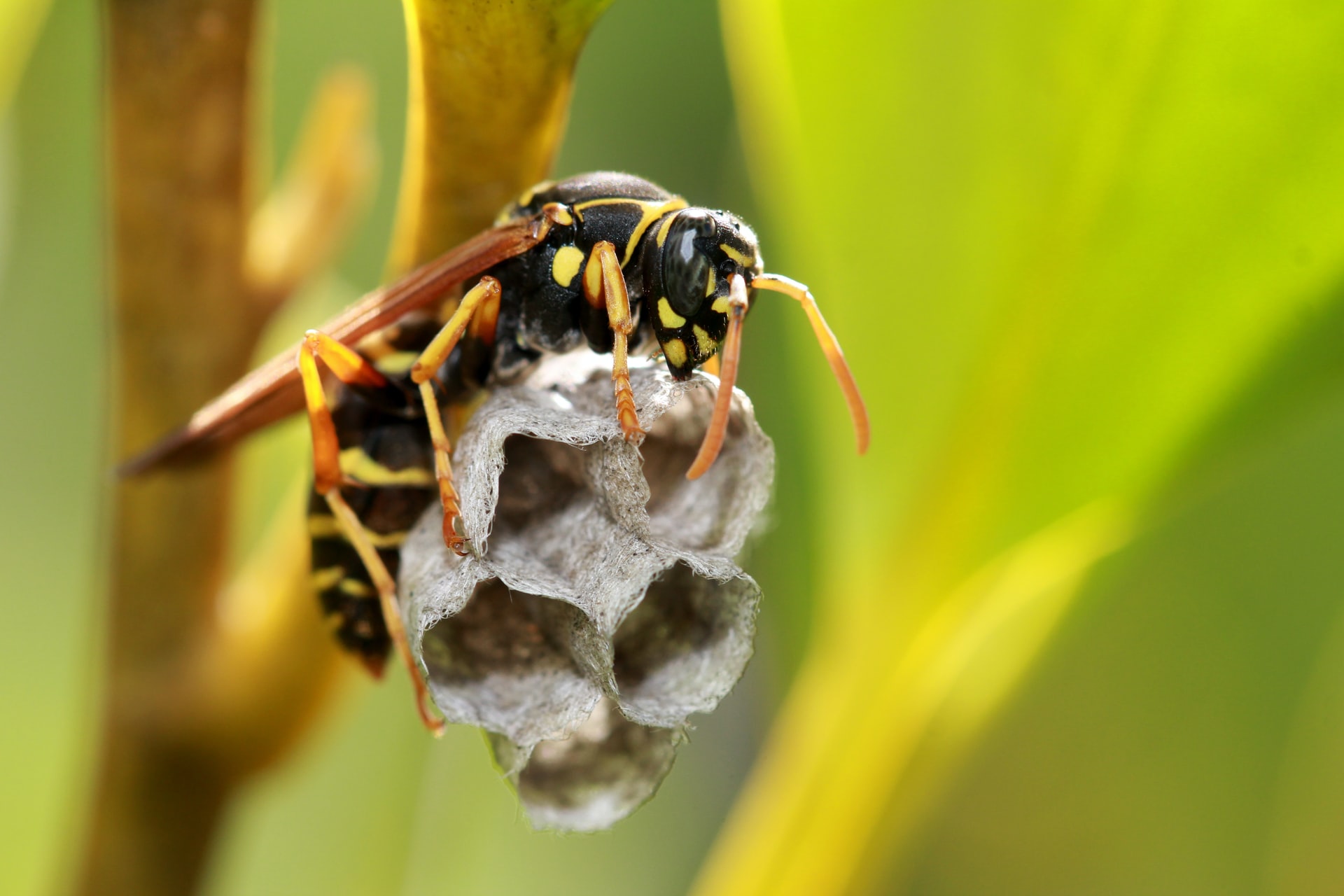
How to Remove Paper Wasps
Paper wasp nests can be removed safely and effectively without the use of toxic pesticides that can harm human and environmental health. Safety first! Wear long sleeves, gloves and eye protection when removing a wasp nest. Check out these Earth-friendly ways of sending the wasps on their way.
- Nighttime removal: Paper wasps sleep at night. Recent research shows that wasps show all the signs of what we consider 'sleep'. They are slow to react if removed in the dark.
- Use red light for night vision: Many invertebrates can't see the color red due to the biology of their eyes and visual sensitivities (but they can see things we can't, like ultraviolet rays!) To avoid detection as you remove the nest, use a red flashlight or headlamp.
- Peppermint oil and other essential oil sprays can be used to deter wasps. It's pretty easy to make. Scientists have studied the effectiveness of this organic deterrent.
- Soapy water: This tried and true non-toxic tactic has been shown to get rid of wasps effectively. Learn more here.
- Additional tips: Don't break the nest open during removal. Doing so might cause the wasps to scatter in all directions around you.
- One option is to wait for the end of the nesting season in the fall. Cold weather brings an end to the use of a nest, and it won't be used again. This is only a valid option in areas with frequent freezing nights in the winter.
Do Paper Wasp Traps Work?
This is worth a straight answer, because hanging a trap is the first thing many homeowners try and it is usually the wrong tool.
Baited traps are built for yellow jackets, not paper wasps. The traps sold at hardware stores work by attracting scavengers — insects that hunt for sugar, meat, and garbage odors away from their nest. Yellow jackets do exactly that, which is why they fill a trap. Paper wasps hunt live caterpillars and drink nectar from flowers; they have very little interest in the sweet or protein baits a trap relies on. You may catch the occasional paper wasp in late summer when sugar-seeking increases, but catch rates stay low compared with yellow jackets.
Even a trap that works doesn’t solve a nest. Traps only intercept foraging adults. The queen keeps laying and the brood keeps developing regardless, so a trap hung near an active comb under your eave will not reduce that colony or make the area safer. This is the key point: trapping is a nuisance-reduction tactic, not nest control.
What actually works on paper wasps, in order of effectiveness:
- Remove new nests early. A knocked-down April or May comb takes seconds and often ends the colony before there are any workers. Check eaves and porch ceilings every couple of weeks in spring.
- Treat mature nests after dark, from 10–15 feet, then retreat immediately — see How to Get Rid of Paper Wasps.
- Exclude them physically. Screen off soffit gaps, cap open pipe and downspout ends, and repaint weathered wood, which doubles as nest-building material.
- Use repellents on preferred surfaces. Peppermint and other essential oil sprays have measurable deterrent effects on Polistes and are worth applying to eaves and railings early in the season, before nests are established.
What to expect little from: decoy nests. They are marketed on the idea that a founding queen avoids a rival colony, but Polistes are frequently observed nesting close to one another in the wild, and the controlled evidence is thin and mixed. A decoy is cheap and harmless to hang in early spring before queens have chosen sites, and some homeowners report success — just don’t count on it, and understand that it has no effect at all on a nest that already exists. Fake Wasp Nest: Do Decoys Really Work? reviews what the evidence does and doesn’t support. If you do want a trap for the scavenging wasps around your patio, our wasp trap guide covers designs, baits, and placement.
Keeping Them Away
Decoy wasp nests are a popular DIY creation, but the evidence behind them is weak. Paper wasps are regularly observed nesting in close proximity to one another, which undercuts the territorial premise decoys rely on, and controlled results have been inconsistent. Treat a decoy as a cheap early-spring experiment rather than a solution — see Fake Wasp Nest: Do Decoys Really Work? for a full look at the research. On the other hand, scientists have found several essential oils to be excellent repellants for paper wasps and other insects. Make sure that screens, windows, siding and other exposed areas are in good condition to discourage wasps from nesting on your home. Keep trash and empty cans inaccessible to wasps. Consider consulting a professional if the nest removal is too dangerous or risky for you. Don't be afraid to ask pest control for Earth-friendly, non-toxic removal.
Cool Facts About Wasps
- Only female wasps can sting. They are much larger than males. Some people even handle male wasps with their hands!
- The stinger is actually an ovipositor used to lay eggs. Fossils indicate that this structure evolved before the time of T. rex to deposit eggs into plants.
- Some males have tiny spikes on their abdomens that allow them to prick an attacker.
- Wasp venom contains more than 30 compounds, including protein toxins and various enzymes.
- Wasps are important pollinators in gardens and farms. They also eat nuisance garden pests like caterpillars.
- Wasps can become invasive species if they are transported to a new area. The common European paper wasps in the US are non-native invasives.
- Queens spend the winter burrowing underground, behind tree bark, or in a similar sheltered area like a home or attic.
- Nests are only used for one season. If winter is coming, they'll likely be gone soon!
Frequently Asked Questions
Are paper wasps aggressive?
Paper wasps are not naturally aggressive and rarely sting people who are simply walking nearby. Their defensive behavior is almost entirely triggered by direct handling, swatting, or getting too close to an active nest. Compared to yellow jackets — which will pursue intruders well away from their nest and sting repeatedly — paper wasps are considered low-to-moderate in aggression. For a comparison of aggression levels across species, see Are Wasps Aggressive?.
Do paper wasps sting more than once?
Yes. Like all wasps (and unlike honey bees), paper wasps have smooth stingers that don’t detach after use. A single paper wasp can sting multiple times, and when threatened, they release alarm pheromones that can recruit nearby nestmates to join the defense. See Can Wasps Sting More Than Once? for more detail.
Can paper wasps recognize human faces?
Yes — research on Polistes fuscatus (northern paper wasp) has shown that these insects can recognize individual human faces, a capability previously thought to exist only in vertebrates. Scientists believe this helps them recognize nestmates from other wasps. See Do Wasps Remember Faces? for more on the science.
When is the best time to remove a paper wasp nest?
The safest window is winter (December–February), when all workers have died and only an empty paper structure remains. For active nests, treat after dark when all wasps have returned to the nest — use an aerosol wasp spray at maximum effective distance (10–15 feet), retreat immediately, and remove the dead nest 24 hours later. Always wear protective clothing. See How to Get Rid of Paper Wasps for step-by-step instructions.
What do paper wasps eat?
Adult paper wasps feed primarily on nectar and other sugary liquids. However, they hunt caterpillars, flies, and other soft-bodied insects to feed their larvae. This makes them genuinely useful in gardens — a single colony can consume thousands of pest caterpillars per season. See What Do Paper Wasps Eat? for more detail.
Are paper wasps beneficial?
Yes. Paper wasps are significant predators of garden and agricultural pests, particularly caterpillars that damage plants. They also provide incidental pollination when visiting flowers for nectar. Unless a nest is in a location where people regularly pass close by, it’s generally better to leave paper wasp nests alone and let them do their work.
What do paper wasps look like?
Paper wasps are slender, 0.75–1 inch long, with a distinctively narrow waist, long legs that dangle below the body during flight, and relatively large wings. Color varies by species: most are yellow-brown with red markings (northern paper wasp), bright yellow and black like a yellow jacket but slimmer (European paper wasp), reddish-brown to orange (apache paper wasp in the southwest), or deep red (red paper wasp in the southeast). The key visual identifier is always the open umbrella-shaped nest with exposed hexagonal cells — if you see that structure, you’re looking at paper wasps.
Do paper wasps make honey?
No. Paper wasps do not make honey. They feed their larvae on insect prey (mainly caterpillars) and adult workers consume nectar from flowers, but they store no food reserves in their nests. This is an important difference from honeybees, which produce and store honey as a winter food supply. Paper wasp colonies die off completely each fall — they have no need to store food because only a few mated queens survive winter, tucked away in protected spots, not in the nest.
Are paper wasps a sign of infestation?
Not typically. One or two paper wasps at a time is normal summer behavior — they’re foraging for caterpillars or nectar. Seeing multiple wasps flying in and out of the same spot repeatedly suggests an active nest nearby. Paper wasp nests are single-colony structures housing 10–75 workers; they’re not signs of a widespread infestation the way ants or cockroaches can be. A single nest in a low-traffic location generally requires no action.
What attracts paper wasps to your house?
Paper wasps are drawn to sheltered, semi-shaded surfaces with good sun exposure — porch ceilings, under deck railings, eaves, and window frames. They’re also attracted by gardens with abundant caterpillars (their preferred prey), flowers for nectar, and water sources. Unpainted or weathered wood is a building material source — wasps scrape wood fiber to make nest paper. To reduce attraction: seal gaps in soffits and siding, apply fresh paint to weathered wood surfaces, and keep outdoor dining areas clean of sweet spills.
How painful is a paper wasp sting?
A paper wasp sting rates 3.0 out of 4.0 on the Schmidt Sting Pain Index — described as “caustic and burning.” The sharp pain peaks within 5–10 minutes, then fades to a dull ache over the next few hours. Most healthy adults experience localized pain, redness, and swelling that fully resolves within 7–10 days. Paper wasp stings are more intense than honey bee stings but generally cause less prolonged pain than yellow jacket stings. See our Paper Wasp Sting Treatment Guide for detailed first-aid steps.
How do you tell a paper wasp queen from a worker?
Mostly by context rather than looks. Paper wasp queens have the same body plan as workers — no distinct queen shape, and only a slight size difference at best. In spring, a single wasp on a small comb is the queen by definition. On a summer nest, she is the wasp that stays on the comb instead of foraging and that other workers defer to. Because workers can also lay eggs, killing the queen alone does not end the colony. See our queen wasp guide for detailed queen-versus-worker identification.
Do paper wasp traps work?
Not well. Baited traps are designed for scavenging yellow jackets that seek out sugar and protein away from the nest. Paper wasps hunt live insects and feed on flower nectar, so they enter baited traps far less often. More importantly, no trap reduces an active nest — it only removes some foraging adults while the queen keeps laying. For a paper wasp comb on your house, early removal or an after-dark treatment is the effective approach.
Will paper wasps come back to the same nest next year?
No. A paper wasp nest is used for one season only and is never reoccupied. Once the colony dies off in fall, the comb is abandoned permanently, so an old nest poses no risk and does not need urgent removal. New queens do, however, favor the same kinds of sheltered sites, so it’s common to find a fresh nest a few feet from last year’s. Removing the old comb in winter and sealing or repainting that spot reduces the odds of a repeat.
How long does a paper wasp sting last?
The sharp pain from a paper wasp sting typically fades within 1–4 hours. Redness and swelling peak at 24–48 hours and then gradually decrease over the next 3–5 days. Complete healing takes 7–10 days for a normal localized reaction. Itching during days 3–5 is normal — it indicates healing. If swelling is still increasing after 48 hours, if you develop a red streak extending from the sting site, or if you have any symptoms beyond the local area (hives, difficulty breathing), seek medical attention promptly.
Related Articles
- Paper Wasp Complete Homeowner Guide — comprehensive overview of identification, behavior, and management
- How to Get Rid of Paper Wasps — step-by-step removal methods for homeowners
- Do Paper Wasps Sting? — understanding paper wasp sting behavior and risk
- What Do Paper Wasps Eat? — diet and foraging habits explained
- Paper Wasp Nest: Identification, Removal, and Prevention — complete guide to paper wasp nests
- Paper Wasp Sting: Treatment, Symptoms & Prevention — first aid and recovery guide
- European Paper Wasp Identification Guide — the invasive species found across the US
- Northern Paper Wasp Identification Guide — the most widespread native paper wasp
- Paper Wasp vs Yellow Jacket — the comparison homeowners get wrong most often
- Paper Wasps in Florida — regional guide for Florida homeowners
- Paper Wasps in Texas — regional guide for Texas homeowners (includes apache paper wasp)
- Red Paper Wasp: Complete Identification and Behavior Guide — in-depth guide to Polistes carolina including sting assessment and nest management
- Apache Paper Wasp: Complete Identification Guide — identification and behavior guide for the dominant paper wasp of the southwestern US
- Guinea Wasp: Complete Identification and Behavior Guide — in-depth guide to Polistes exclamans, a common paper wasp across the southern and eastern US
- Red Wasps — identification and comparison with reddish paper wasp species including apache paper wasps
- Queen Wasp: Identification, Size & Lifecycle — queen versus worker identification across all wasp species
- Complete Guide to Wasp Nests — every nest type compared side by side
- Mud Dauber Wasp Guide — the solitary mud-nesting wasps most often mistaken for paper wasps, and how to tell a mud nest from a paper comb
- Hornet Nest vs Wasp Nest — telling enclosed aerial nests apart
- What Eats Wasps? — natural predators and parasites of paper wasps
- Wasp Trap Complete Guide — which traps work, and on which species
Helpful Links
https://www.clemson.edu/extension/beekeepers/fact-sheets-publications/paper-wasps.html
http://idl.entomology.cornell.edu/wp-content/uploads/Paper-Wasps-CCE.pdf
https://agrilifeextension.tamu.edu/library/insects/paper-wasps-yellowjackets-and-solitary-wasps/
https://askentomologists.com/2015/09/23/why-cant-male-bees-or-wasps-sting/
https://bugguide.net/node/view/572
https://onlinelibrary.wiley.com/doi/abs/10.1002/ps.3411